Chapter 25 — cov, posterior, and resume: running and comparing the engines
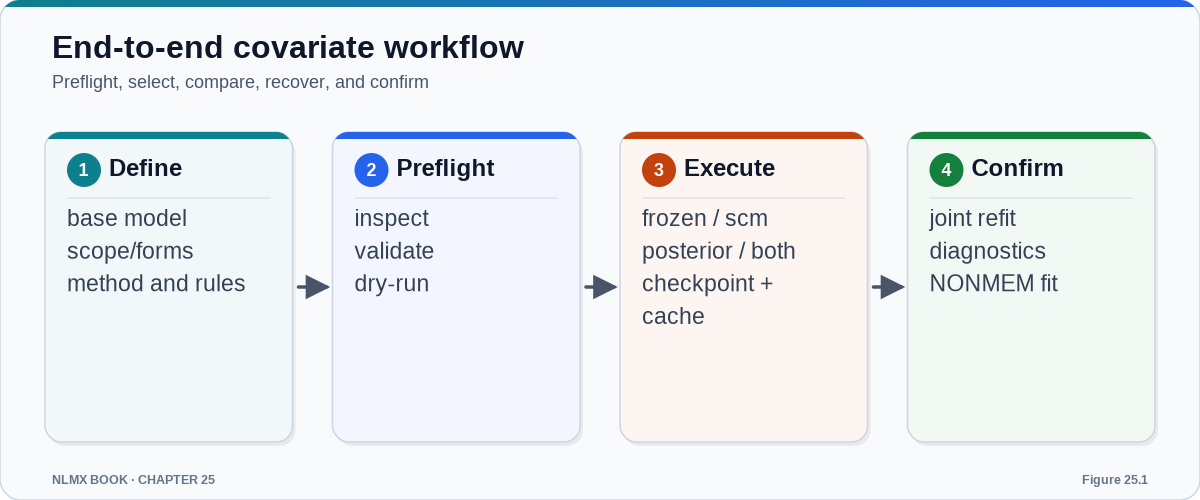
Chapter 25 turns the statistical methods of Chapters 22–24 and 23A into one auditable operating workflow. It shows how to create a versioned .covar configuration, inspect and validate the resolved analysis, run frozen, scm, posterior, or both, distinguish the standalone posterior-reconstruction command from posterior selection, recover interrupted work safely, read cross-engine comparisons, and carry a selected set through joint refitting, diagnostics, and reference-software confirmation.
What you will learn
- how configuration defaults, TOML values, and CLI overrides become one normalized analysis;
- what
schema,inspect,validate,cov,posterior, andresumeeach do—and where each stops;- how to select among frozen, refit-based SCM, posterior stability, and combined execution;
- how posterior checkpoints and frozen/SCM refit caches preserve work without changing the scientific question;
- how
method = "both"organizes outputs and labels agreement without combining unlike statistics; and- how to validate operating characteristics and report every engine, failure, recovery, and fitted endpoint.
Prerequisites: Read Chapter 22 for covariate modelling concepts, Chapter 23 for efficient-score evidence, Chapter 23A for refit-based SCM, and Chapter 24 for posterior stability.
Executed 4.14.3 evidence
The worked material uses the Chapter 22 60-subject, 480-observation FOCE-I base and a five-relationship scope: CL–WT, CL–EGFR, CL–SEX, V–WT, and V–SEX. Preserved commands exercise inspect, validate, standalone posterior, cov --method both, a real interrupted posterior schedule, successful resume with a changed thread count, and the protective refusal to resume a completed run.
The compact combined teaching run retained V–WT in both engines and rejected both null SEX relationships in both. CL–EGFR was uncertain in both; CL–WT was frozen-uncertain but posterior-retained. Those differences are intentionally retained to teach why engine comparison is an investigation workflow, not a vote. The recovery demonstration captured an incomplete state at 4 of 800 learner fits, resumed it to the exact endpoint, then received the expected exit code 11 on a second resume attempt.
Reading paths
New users should read pages 25.1–25.20 in sequence. Analysts preparing a run can begin with the complete command and settings index, inspect, validate, and method selection. Reviewers can begin with analysis identity, comparison interpretation, the recovery example, and the complete checklist.
This chapter describes nlmx 4.14.3. A run is reproducible only with its version, exact inputs, resolved settings, seeds, and evidence bundle—not from the command name alone.