27.20 Categorical stratification
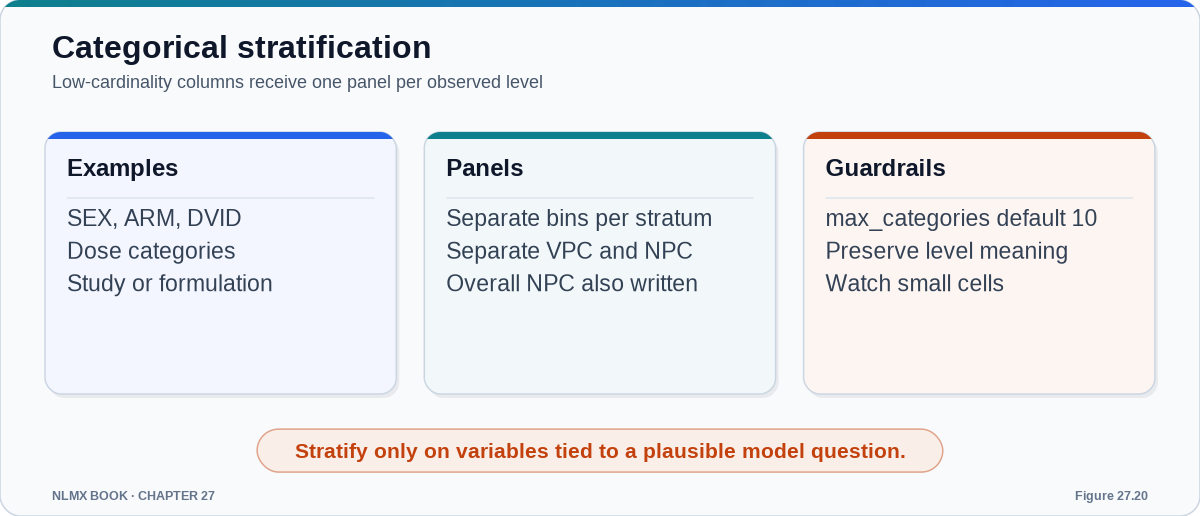
A column with at most max_categories distinct values is treated as categorical and gets one stratum per value. Examples include SEX, ARM, dose group, formulation, study, DVID, or CMT. Each stratum receives separate bins, VPC/BLQ panels, and NPC results; an overall NPC is also written.
Novice translation
This topic changes three practical decisions in a predictive-check review. First, use $INPUT names as seen by the model after renaming and dropping. Second, strata are assigned at each observation record, so time-varying categories may move a subject’s observations between panels. Third, file-safe stratum names appear in SVG and publication filenames while the tables retain readable labels. Keep those decisions separate: one defines what is simulated or summarised, another controls how evidence is displayed, and the last controls what conclusion the evidence can support. A reviewer should be able to reproduce each decision from the resolved settings and numerical tables, not infer it from the appearance of the figure.
What to understand
- Use
$INPUTnames as seen by the model after renaming and dropping. - Strata are assigned at each observation record, so time-varying categories may move a subject’s observations between panels.
- File-safe stratum names appear in SVG and publication filenames while the tables retain readable labels.
Practical interpretation
Stratify on a variable connected to a plausible mechanism or model assumption, not every available column.
Evidence to retain
For categorical stratification, retain the issued command, vpc_settings.vpc, the source model/data/result identifiers, seed and replicate count, the relevant CSV/JSON fields, warnings and notes, and the exact figure used for interpretation. Record any sensitivity run that changed the conclusion. If an option was selected after seeing the data, label that analysis exploratory. This evidence separates a reproducible diagnostic decision from a visual impression and lets another pharmacometrician check counts, transformations, exclusions, and uncertainty assumptions.
Common mistakes
- Pooling different endpoints
- Ignoring tiny category counts
- Treating record-level strata as baseline groups
Page checklist
- Define category meaning
- Count subjects/observations
- Inspect each panel
- Control multiplicity
Further reading
See previous page, next page, complete VPC command and settings index.