The reference subject and denominator
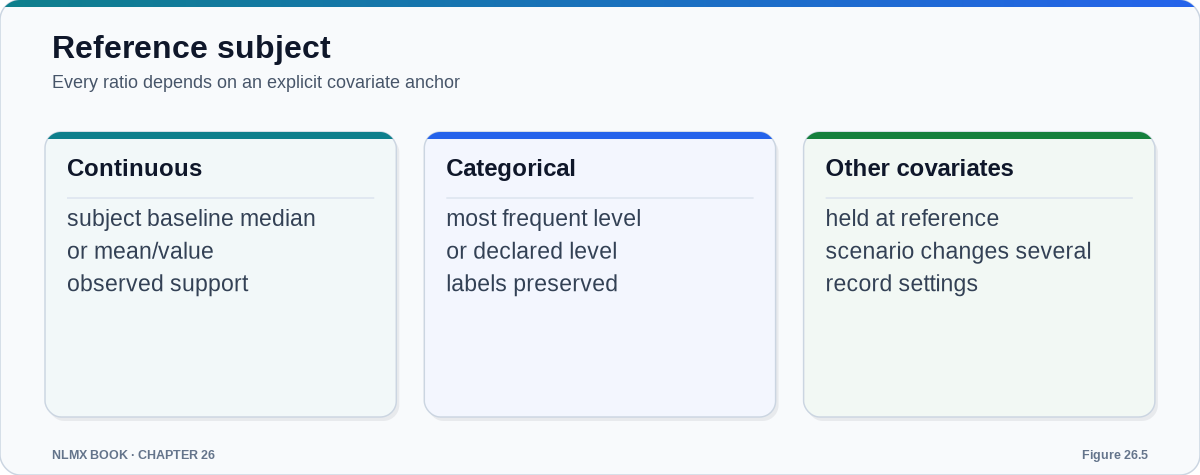
Every ratio is anchored to a reference subject. By default, continuous covariates use the median of each subject's first value and categorical covariates use the most frequent baseline level. [reference] in a .forest file can set explicit values; record the rationale and units.
The reference is not necessarily an actual enrolled subject. It is a covariate vector used to evaluate the model with ETA = 0. When one row changes WT, EGFR and all other covariates remain at reference. A scenario changes the listed vector components simultaneously.
Changing the reference changes reported ratios and coefficient interpretation but not the fitted model. Regulatory or clinical comparisons should select a stable, meaningful anchor prospectively. Always state references in the report and inspect whether they lie within supported data regions.
Common mistakes
- Treating a forest ratio or reference-band class as covariate-selection evidence, causality, or an automatic dosing recommendation.
- Omitting the reference subject, uncertainty source, regimen, subgroup denominator, data support, or fitted-model diagnostics.
- Confusing parameter-uncertainty intervals, BSV ranges, and subject-bootstrap intervals because they share one graphic.
Page checklist
- The numerator, denominator, fitted model, covariate settings, and units are explicit.
- The interval source and clinical meaning are distinguished from BSV and selection uncertainty.
- Tables, resolved settings, commands, diagnostics, limitations, and confirmation evidence are retained.