19.8 Adaptive scales and acceptance
After each iteration, random-walk scales update as
\(s\leftarrow s[1+0.4(\text{acceptance}-\text{IACCEPT})]\), clamped to [0.01,10]. With default target 0.4, acceptance above target expands steps; acceptance below target contracts them.
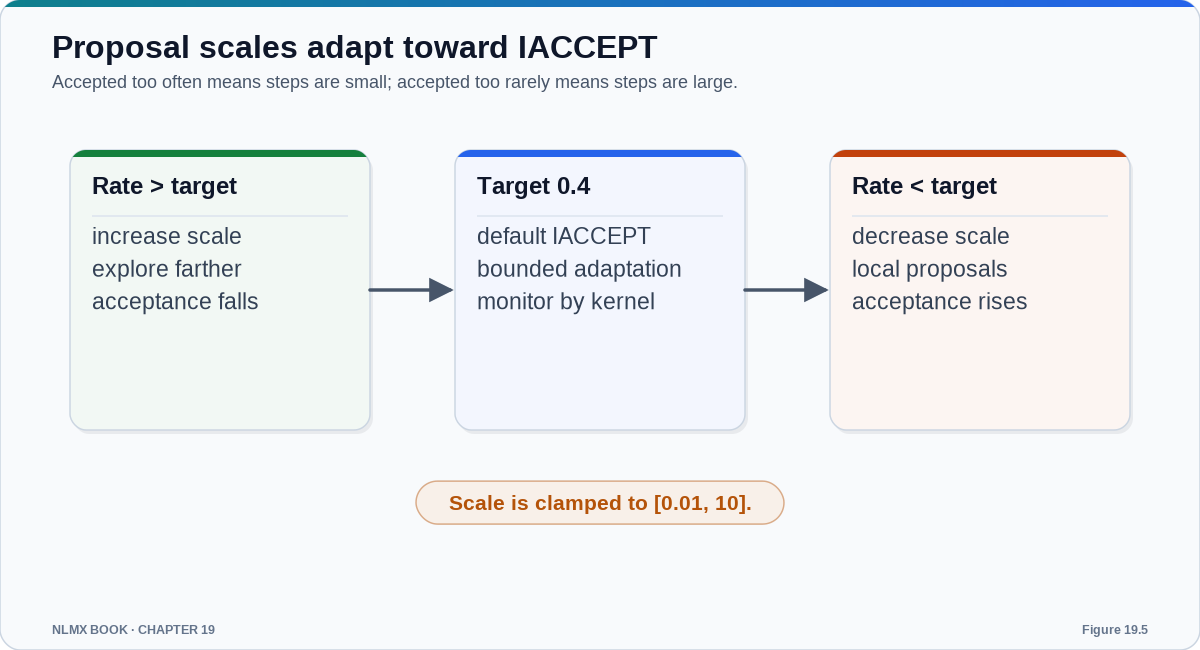
Adaptation balances movement and acceptance. A very high rate may mean tiny, highly autocorrelated steps. A very low rate means proposals rarely move. Target rate is pragmatic, not proof of effective sampling.
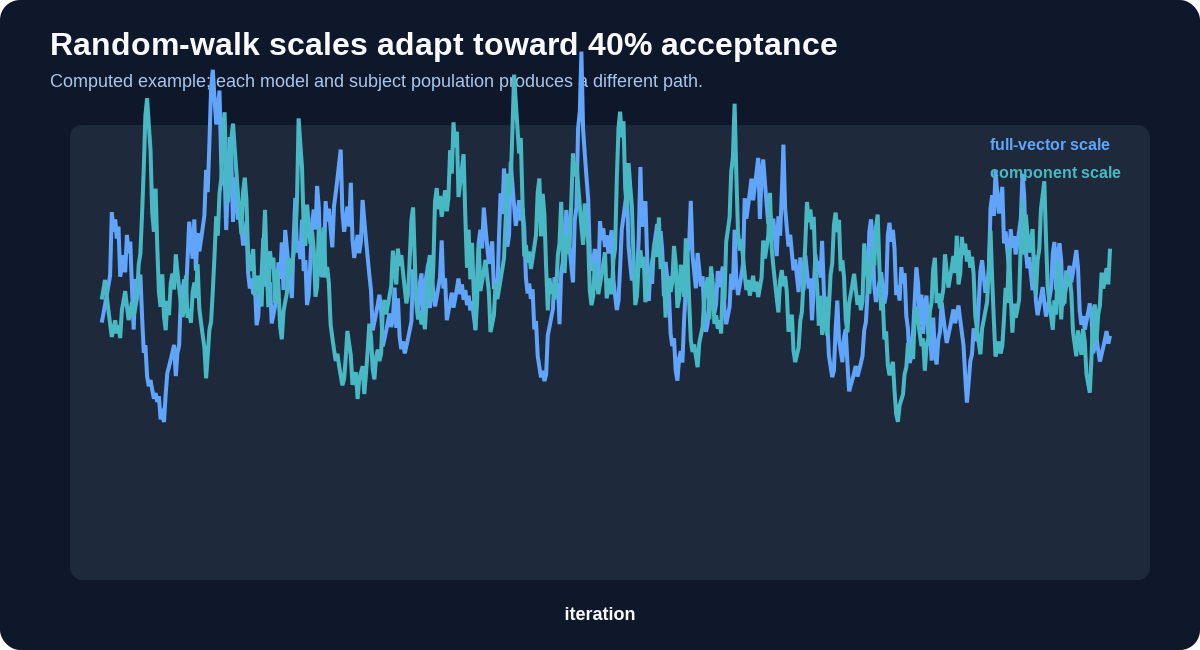
Review prior, full-walk and component rates separately. The prior kernel often remains low. Also inspect trace movement, autocorrelation, scale bounds and between-seed stability.
Practical interpretation
Use a four-panel diagnostic: acceptance by kernel, scale by kernel/coordinate, ETA trace, and cumulative movement distance. Target acceptance with near-zero movement exposes tiny steps; broad movement with low acceptance may still explore. If scale hits a clamp, record when and whether the chain recovers. Do not hand-tune after inspecting one favorable seed; define recovery rules before reruns.
Adaptation occurs while population parameters and OMEGA also change, so early rates are transient. Give more weight to late burn-in behavior while retaining the full path for troubleshooting.
Compare scale trajectories across independent seeds; persistent clamp behavior is more concerning than one transient excursion. Keep target and update coefficient in the run record.
Common mistakes
Do not tune all kernels toward the same observed rate, report only an overall average, or treat target acceptance as a convergence criterion. A chain can accept 40% within one local mode forever.
Checklist
- Record rates by kernel and phase.
- Plot scales through burn-in.
- Flag bound-hitting scales.
- Inspect movement and multiple seeds.
- Keep adaptation settings fixed for comparison.
Further reading
See the generated csvSAEM trace and burn-in.