Covariance-based parameter uncertainty
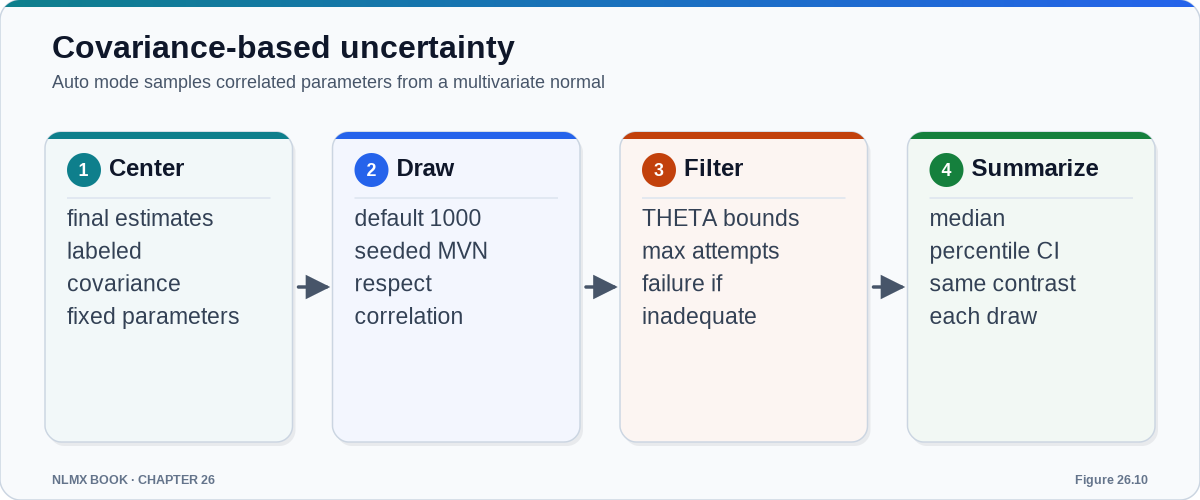
With uncertainty = "auto", nlmx uses the fitted .cov when available. It samples parameter vectors from a multivariate normal centered on the final estimates, preserving labeled covariance and correlation. Default count is 1000; --samples, --ci, and --seed control the draw distribution and percentile interval.
Each draw is passed through the same numerator and denominator model evaluations, so uncertainty in base and covariate parameters and their covariance propagates into the ratio. Fixed parameters remain fixed. The plotted black point is the ratio at final estimates; the reported draw median can differ under nonlinearity.
MVN covariance sampling is an approximation. Near-boundary parameters, asymmetric likelihoods, poor covariance conditioning, or uncertain model selection can make it inadequate. Preserve the covariance source and diagnostics and consider bootstrap/SIR parameter sets.
Common mistakes
- Treating a forest ratio or reference-band class as covariate-selection evidence, causality, or an automatic dosing recommendation.
- Omitting the reference subject, uncertainty source, regimen, subgroup denominator, data support, or fitted-model diagnostics.
- Confusing parameter-uncertainty intervals, BSV ranges, and subject-bootstrap intervals because they share one graphic.
Page checklist
- The numerator, denominator, fitted model, covariate settings, and units are explicit.
- The interval source and clinical meaning are distinguished from BSV and selection uncertainty.
- Tables, resolved settings, commands, diagnostics, limitations, and confirmation evidence are retained.