Chapter 41 — Worked case studies
What you will learn
- Follow nine analyses from a question, through the evidence the program produced, to a decision.
- Recognise, in each, where the decision was easy, where it was refused, and where the evidence was too thin to decide.
- Re-check one number on every page against the file it came from.
- Keep a decision log that says what was decided, on what evidence, and whether it can be undone.
Prerequisites: Chapters 3 and 11–36A for the commands, and Chapter 42 for what evidence means.
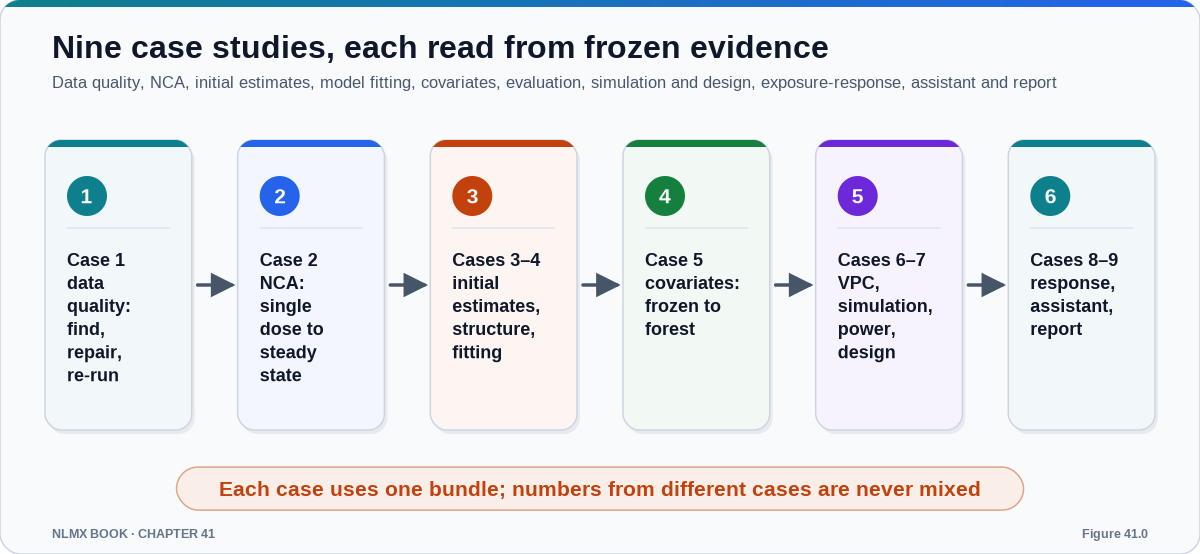
Chapters 11 to 40 each explain one command or method. This chapter takes one question at a time. It opens the frozen outputs that the program wrote for that question, reads them as an analyst would, and ends on a decision. The nine cases follow the order of a real project: data, exposure, model, covariates, evaluation, design, response, and the tools that wrap the work.
What makes a case a case
- One bundle per case. Every number is read from a named file in a frozen bundle, and numbers from different bundles are never mixed (41.1).
- A decision at the end. Each page closes on a table: question, evidence, decision, reversible? (41.2). A decision that cannot be reversed is marked, and is the one to slow down for.
- Hand checks. Wherever the arithmetic is short enough, the page recomputes a number from the printed parameters (a clearance from a closed form, a power from a standard error, an odds ratio from a slope), so that the program's output is checked by something other than the program.
- Limits stated. Each page ends with what its bundle does not show.
The nine cases
Case 1: Data quality
Is this file ready for analysis?
| Page | Title |
|---|---|
| 41.3 | A dirty file, line by line |
| 41.4 | A repair plan and the clean re-run |
| 41.5 | The gate and the handover |
Case 2: NCA
What are the exposure parameters, and do they scale with dose?
| Page | Title |
|---|---|
| 41.6 | One oral dose, from profile to parameters |
| 41.7 | An infusion and a steady-state interval |
| 41.8 | Is exposure proportional to dose? |
| 41.9 | Bioavailability from a crossover, and a sparse study with BLQ |
Case 3: Initial estimates and structure
Where should the fit start, and which structure does the data support?
| Page | Title |
|---|---|
| 41.10 | Where should the fit start? |
| 41.11 | Which structure does the data support? |
| 41.12 | From a recommendation with a caution to a fit |
Case 4: Fitting
Did the model converge, and how much does the method matter?
| Page | Title |
|---|---|
| 41.13 | A FOCE-I fit, read line by line |
| 41.14 | Three estimation methods, one answer |
| 41.15 | Does the block OMEGA earn its extra parameter? |
| 41.16 | A fit that recovers, and what to check afterwards |
| 41.17 | Iteration limits, evaluate-only, and reading the ending |
Case 5: Covariates
Which covariates belong in the model, and how stable is that answer?
| Page | Title |
|---|---|
| 41.18 | The covariate question and its base model |
| 41.19 | The frozen engine, step by step |
| 41.20 | Stepwise covariate modelling on refits |
| 41.21 | Five variants of the screen, and the one that fails |
| 41.22 | Stability selection, and how often each candidate is chosen |
| 41.23 | Three engines side by side, cheap checks first, and a run that survived an interruption |
| 41.24 | A forest plot, rebuilt by hand |
Case 6: Evaluation
Does the model describe the data it was built from?
| Page | Title |
|---|---|
| 41.25 | A prediction-corrected VPC of the final model |
| 41.26 | A pooled check that passes and a stratified check that does not |
| 41.27 | The numerical check, censored observations and parameter uncertainty |
Case 7: Simulation and design
What exposure and power will this design give?
| Page | Title |
|---|---|
| 41.28 | Dose levels against an exposure window |
| 41.29 | Children, weight-based doses and mixed populations |
| 41.30 | Three checks on a simulation before it is trusted |
| 41.31 | Four generated projects, a known truth and a design to review |
| 41.32 | A covariate method tested on known truth, with too few replicates |
| 41.33 | How many subjects, from the Fisher information |
| 41.34 | Power by simulation and estimation, and what the formula missed |
Case 8: Exposure–response
Is response related to exposure, and how strongly?
| Page | Title |
|---|---|
| 41.35 | One exposure, three endpoint types |
| 41.36 | A change score, a survival time and a score over visits |
Case 9: Assistant and report
Can a conversation set up a run, and can the result be reported?
| Page | Title |
|---|---|
| 41.37 | The assistant, and what its guardrails do with nine different replies |
| 41.38 | One Markdown file, three ways in, and what "done" means |
Four threads through the cases
Reading the chapter in order, four ideas return.
- A gate before the analysis. Case 1 shows a file that must not be analysed and a repair plan, and ends with an exit code that a script can act on. Every later case begins from data that passed.
- Agreement between independent routes. Autoinit's three routes, three estimation methods, three covariate engines, a formula and a simulation for power: when two methods agree the finding is stronger, and when they do not (41.12, 41.19, 41.34) the disagreement is the finding.
- Intervals, not point values. Parameters have RSEs, powers have Wilson intervals, an EC50 can have an interval from 0.97 to 139, and a false-positive rate of zero from two replicates is bounded only by 0.66. The cases insist on saying how well a number is known.
- Refusals and failures are results. A refused data set (41.3, 41.32), an iteration limit (41.17), an observed-information variant that fails (41.21), a setting rejected before it is written (41.37): each is shown with the same care as a clean run.
How to read the chapter
- In order, if you are learning the workflow.
- By question, if you have one: the table above gives the question of each case.
- For the numbers, use the complete case-study reference: every bundle, the page that uses it, and the headline result.
Review checklist
- Can you say, for a case you have read, what the decision was and what would have changed it?
- Do you know which of the decisions were irreversible?
- Can you name a case in which the right answer was "do not decide yet"?
Navigation
See the first page of the chapter, the complete case-study reference and Chapter 42.