16.33 Worked example: unit scaling and transit blocks
This example isolates two features that are easy to confuse: measurement-unit scaling and absorption-model scaffolding. Sixteen oral subjects receive doses recorded in milligrams while concentrations are recorded in ng/mL. The command uses NLS only, supplies the dose and concentration units as a pair, and requests transit absorption blocks.
Files:
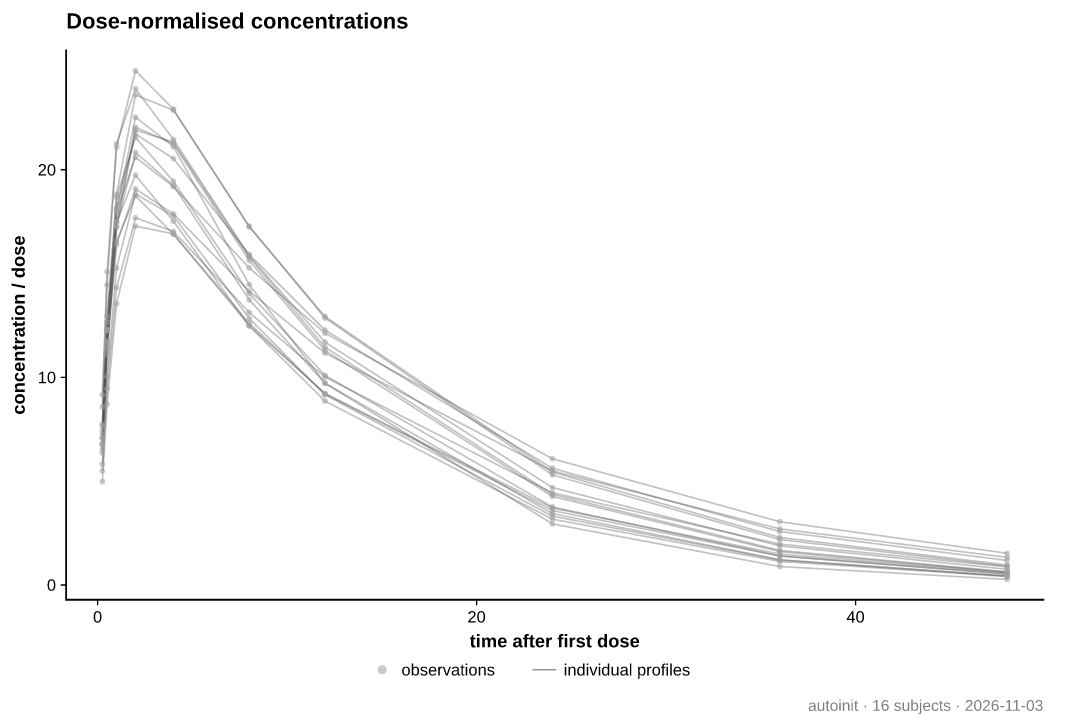
Reading the estimates and scale statement
The NLS-only recommendation is CL/F = 3.023 L/time, V/F = 39.814 L, and KA = 1.300 per time. Only the NLS column contributes, so the recommended column equals it. The generated control-stream text includes S2 = V/1000, which maps a milligram amount in a volume expressed in litres to a concentration recorded in ng/mL under this convention. Always verify the formula dimensionally against the target software and dataset; do not copy it merely because the numeric starts look plausible.
The additive error start is about 31.77 in the recorded concentration units, whereas the proportional error reaches the 0.03 floor. Changing concentration units changes the numeric additive error and scale statement. It should not change the underlying biological clearance or volume once units are converted consistently.
What --absorption transit does
The transit selection adds absorption-model block text to init_blocks.txt. It does not refit transit parameters or change the CL, V, and KA estimates in initial_estimates.csv. Treat the generated transit values as runnable scaffolding that needs deliberate estimation, parameterisation, and identifiability checks in the downstream model.
This distinction matters for reproducibility: two runs with the same input and estimation method but different requested absorption block styles can have the same estimated parameter table while producing different control-stream snippets.
Common mistakes
- Supplying only
--dose-unitor only--conc-unit; the pair is required. - Combining the explicit unit pair with
--scale. - Interpreting
S2as a fitted pharmacokinetic parameter. - Claiming transit kinetics were learned from the data.
- Comparing additive error values across different concentration units without conversion.
Checklist
- Write the dose, amount, volume, and concentration dimensions on paper.
- Confirm the unit pair is complete and not combined with
--scale. - Verify the generated
S2equation against the target model. - Confirm recommended values equal NLS in this single-method run.
- Review and estimate transit parameters downstream rather than accepting scaffolding as evidence.
Further reading
See scaling and S-lines, multicompartment and transit blocks, single-method runs, and using blocks safely.