Appendix B — Glossary
What you will learn
- Find the meaning of any term of the book, in the sense the book uses it, and the chapter that teaches it.
- Tell variance, standard deviation and coefficient of variation apart; an OFV from a difference of OFVs; a censored value from a missing one.
- Read a dataset row, a control stream, an exit code and an assistant session with the right words.
- Look up an abbreviation by its letters.
Prerequisites: none. The glossary can be read from the start, as a short course in the vocabulary, or used as a lookup.
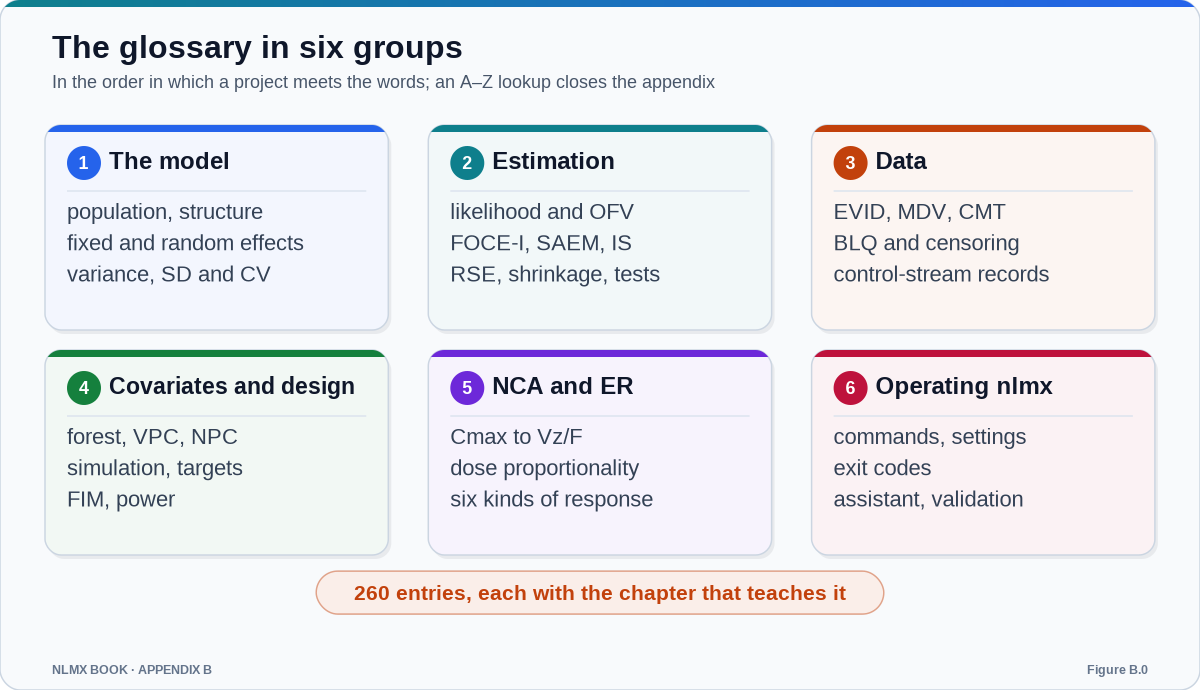
The book uses a pharmacometric vocabulary that is mostly standard and occasionally specific to the program. This appendix fixes both. It is organised in six groups that follow the order in which a project meets the words, with one worked example on each page and an A–Z lookup at the end.
| Group | Page | What it defines |
|---|---|---|
| The model | B.1 | population, structural model, compartments and the pharmacokinetic parameters, fixed and random effects, residual error; variance, SD and CV |
| Estimation and inference | B.2 | likelihood and the OFV; FO, FOCE, FOCE-I, Laplace, SAEM, importance sampling; the covariance step, RSE, shrinkage; the tests and criteria |
| Data and control streams | B.3 | dataset columns and event types, BLQ and censoring, control-stream records, the files of a run |
| Covariates, evaluation and design | B.4 | covariate selection, forest plots, VPC and NPC, simulation, typical subject, targets, Fisher information, power and sample size |
| NCA and exposure–response | B.5 | Cmax to Vz/F, trapezoids and the terminal slope, dose proportionality, bioavailability; the six kinds of response and their models |
| Operating nlmx | B.6 | commands, settings, outputs, exit codes, the assistant, reports, validation words |
| Lookup | the A–Z reference | 260 entries and abbreviations, each with the page that defines it |
Conventions of the glossary
- An entry has the form term (symbol or alternative name) — definition, and names the chapter that uses it. A symbol is the one used in Appendix A.
- Variance, SD and CV are different numbers for one spread. Wherever the book gives an OMEGA, the column says which it is; page B.1 has the conversion.
- Illustration, not a result. A worked example on these pages uses invented numbers, or the numbers of the appendix subject, and is marked as such.
- Where a term differs between the field and the program, the entry says which sense the book uses, and the page of the chapter gives the detail.
How to read it
- A newcomer? Read B.1 and B.2 in order, then the page of the command you are about to use.
- Reading a listing or a table? Use the A–Z lookup to find the page that defines each heading.
- Writing a report? Take the wording of the page, and cite it when a term is used in a special sense.
The appendix has six numbered pages, this overview and the lookup: eight Markdown pages in total. Continue with B.1.