16.1 Why initial estimates matter
Population-model estimation is an iterative search. It starts from proposed fixed effects, variability, and residual-error values, evaluates likelihoods, and moves toward an optimum. A starting point with the wrong order of magnitude can produce numerical overflow, boundary solutions, misleading local minima, slow convergence, or a failed covariance step.
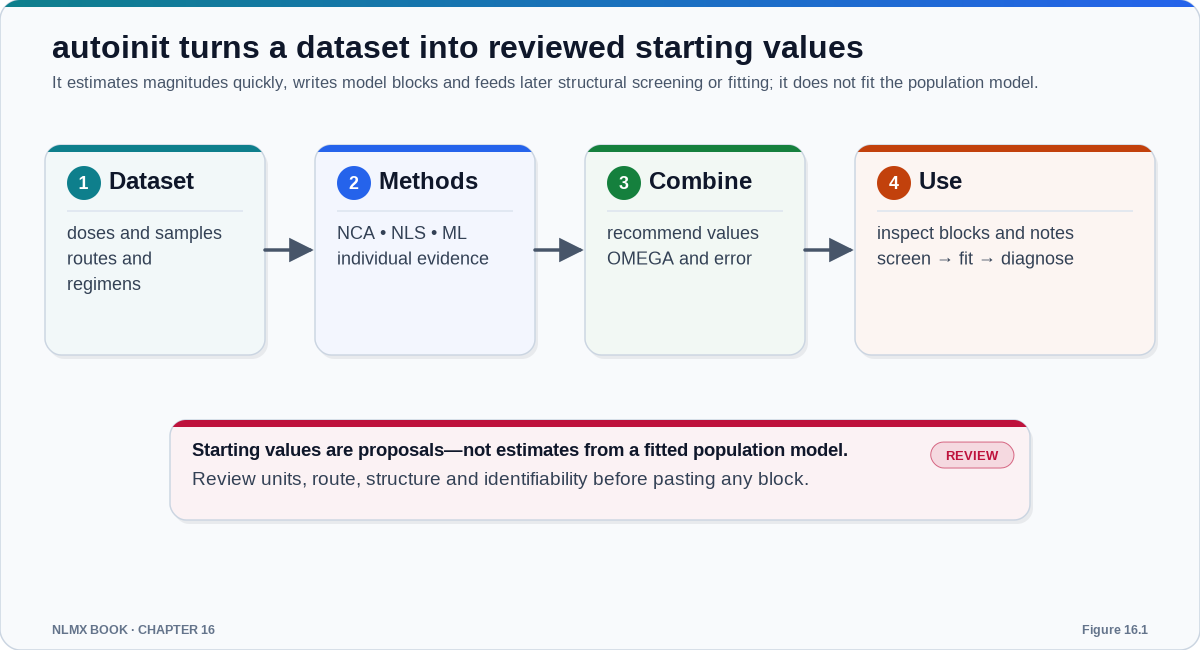
autoinit provides data-informed values quickly so the first structural screen or fit begins in a plausible region. It does not estimate the final population model and does not account for every covariate, inter-occasion effect, residual structure, or nonlinear mechanism.
What “good” means
A useful starting value need not be unbiased. If true CL is 5 and autoinit proposes 4.5, a robust estimation algorithm can often refine it. A proposal of 0.005 caused by a unit error can break the workflow. Evaluation should therefore emphasize scale, route, structural compatibility, and downstream convergence—not cosmetic closeness to one expected value.
Starting OMEGA and residual error also matter. Near-zero variability can trap an ETA at a boundary; huge variability can destabilize individual estimation. The generated values are pragmatic suggestions with floors and safeguards, not formal variance-component estimates.
Three complementary views
NCA uses areas and terminal decline. NLS fits mechanistic curves subject by subject. ML compares observations with simulated profiles under each subject's design. Agreement among them is reassuring. Disagreement is informative: it can indicate sparse sampling, multi-compartment behavior, flip-flop ambiguity, wrong route, censoring, or a unit problem.
The output keeps all method columns and explains the recommendation in SOURCE and NOTE. Review them before copying blocks.
Common mistakes
- Reporting autoinit values as final pharmacokinetic estimates.
- Judging usefulness only by closeness to a literature mean.
- Ignoring method disagreement and source notes.
- Pasting generated blocks without checking model/data conventions.
Checklist
- Verify magnitude and dimensions.
- Check route and apparent-versus-systemic naming.
- Review all available method values.
- Inspect OMEGA/error safeguards.
- Confirm later fit convergence and diagnostics.
Further reading
Continue with the first run, method overview, and Chapter 17's structural screening.