12.21 Parameter corrections: bounds, zero_fix and block_pd
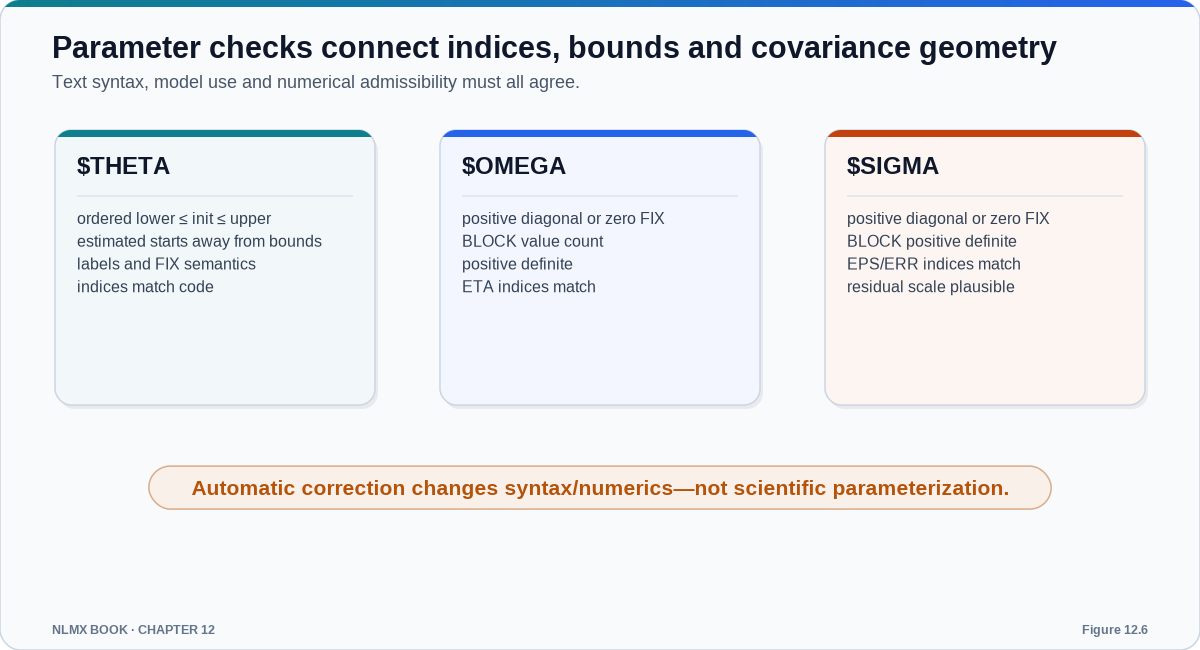
The parameter corrections are bounds, zero_fix, and block_pd. They can turn invalid parameter syntax or starting covariance structures into runnable forms, but they also touch the numerical and scientific core of a model. Review them more strictly than whitespace corrections.
bounds
bounds addresses recognizable THETA-bound defects. In the teaching model, (10,5,1) becomes (1, 5, 10). Ordering the values resolves PAR02, but the tool cannot know whether the author intended a lower bound of 1, an upper bound of 10, or entirely different values. Verify the units, parameter label, plausible population range, and transform.
zero_fix
zero_fix makes a zero diagonal OMEGA or SIGMA explicit by adding FIX. This avoids estimating a variance from a boundary start. It does not decide whether variability should be absent. For the example, $SIGMA 0 FIX is coherent syntax, but a real observation model with no residual variability would demand a strong scientific justification.
block_pd
block_pd repairs a covariance block that is not positive definite. Such a repair can be useful for generating a legal starting matrix, but it changes variances or covariances. Inspect the original and corrected matrices, their eigenvalues or Cholesky decomposition, resulting correlations, and parameter labels. A repaired starting matrix does not guarantee that estimation will remain positive definite.
Common mistakes
- Accepting reordered bounds without recovering the author's intent.
- Fixing zero variance when a positive starting estimate was intended.
- Evaluating a block only by positive definiteness and ignoring implausible correlations.
- Comparing fits without noting changed starting values.
Checklist
- Classify each change as syntactic, numerical, or scientific.
- Verify labels, units, transforms, and parameter indices.
- Compare original and corrected covariance matrices numerically.
- Refit from justified alternative starts.
- Record the review decision and rationale for every parameter edit.
Further reading
See THETA checks, OMEGA/SIGMA checks, and worked example.