Both-direction search
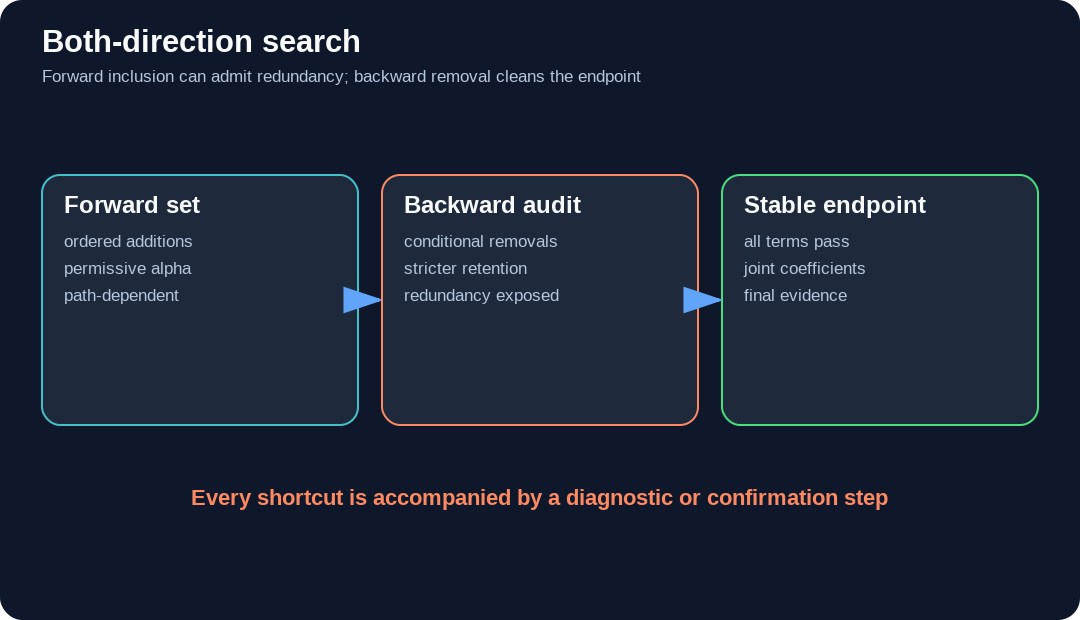
The default both direction performs forward inclusion to its stopping point and then backward elimination on the selected endpoint. The forward threshold is often more permissive (default 0.05) than the retention threshold (default 0.01). Consequently a term can enter early but later be removed when its conditional contribution weakens.
This two-stage logic is useful for correlated covariates and suppression effects, but it is not a bidirectional loop that returns to forward search after each backward deletion. Once the forward stage ends, nlmx prunes; it does not reopen every excluded candidate after a removal. Document this distinction when comparing against other SCM implementations.
The verified example selected V–WT, CL–WT, and CL–EGFR in the forward stage. All three passed the 0.01 backward audit, so no removal occurred. Matching endpoints across both, forward, and backward increased confidence for this controlled example, but it does not guarantee the same agreement in a correlated clinical dataset.
Common mistakes
- Treating a stepwise p-value as clinical importance or causal proof.
- Reading a candidate comparison without its active model, convergence state, degrees of freedom, and exact threshold.
- Reporting only the terminal relationship list while discarding failed models, path decisions, configuration, and provenance.
Page checklist
- The scientific question, model identities, and comparison direction are explicit.
- Numerical validity is reviewed before interpreting statistical evidence.
- The result is linked to the complete trace and final joint-model diagnostics.