21.24 Predose, F_FLAG, and excluded records
Blank residuals can be correct and informative. Three common causes are non-observation event rows, excluded no-drug observations, and general-likelihood records. Preserve these distinctions rather than replacing all blanks with one missing code.
By default, nlmx excludes an observation taken before any drug has been given when the model predicts zero. The row remains in predictions.csv with EXCL = 1, PRED = IPRED = 0, and blank residuals; no_drug_records.csv records its reason. Such rows are omitted from GOF plots and EPS shrinkage. --keep-predose changes the likelihood and is appropriate only when the model can explain baseline observations or strict reference-software reproduction requires inclusion.
F_FLAG != 0 identifies a nonstandard likelihood contribution such as a censored-data formulation. Standard residuals are not defined in the ordinary Gaussian sense, so nlmx leaves them blank and excludes those rows from standard GOF scatter plots. Evaluate the likelihood with censored proportions, probabilities, predictive distributions, or other outcome-specific methods.
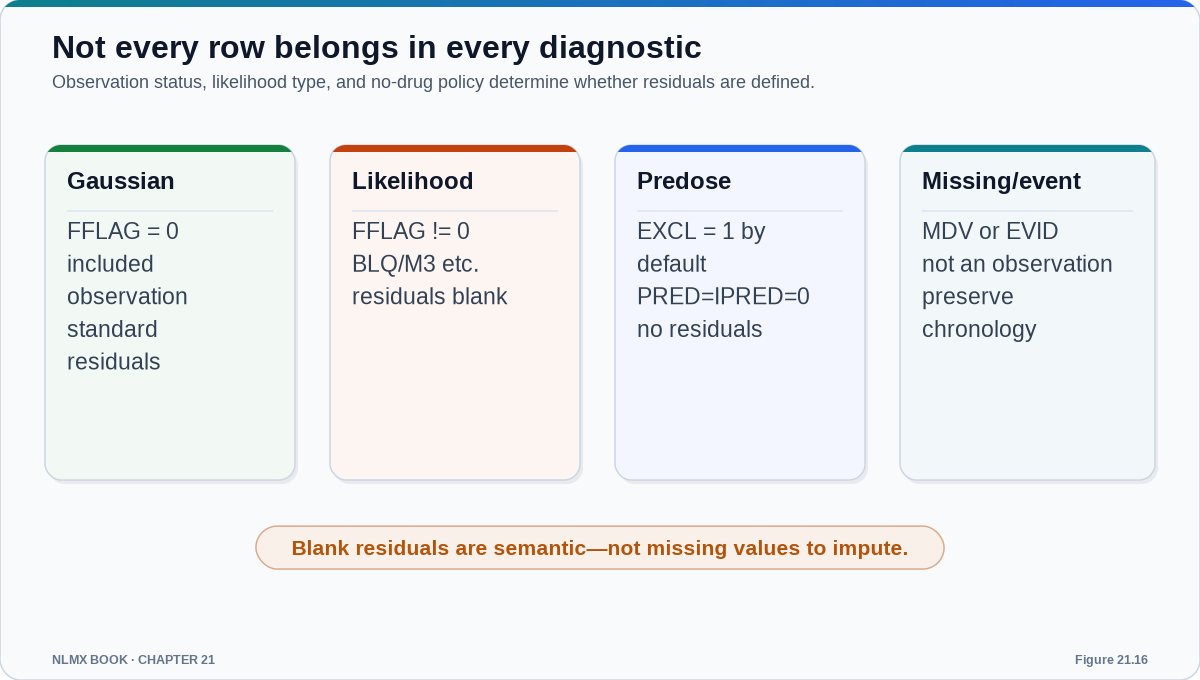
Audit counts by subject, study, endpoint, and time. Unexpected predose exclusions can reveal missing doses, wrong EVID/MDV/CMT, sorting errors, or incomplete treatment history. Unexpected F_FLAG patterns can reveal outcome-routing errors. Do not infer correctness from the total count alone.
Retain representative record-level examples in the review notes so another analyst can verify why each status class does or does not receive an ordinary residual.
Common mistakes
- Imputing blank residuals as zero.
- Treating every predose concentration as an outlier.
- Keeping predose rows without a baseline/endogenous model.
- Applying Gaussian GOF plots to FFLAG likelihood records.
- Ignoring subgroup concentration of exclusions.
Checklist
- Reconcile EVID, MDV, FFLAG, EXCL, and residual missingness.
- Review
no_drug_records.csvby subject and design group. - Justify the predose likelihood policy.
- Use outcome-appropriate diagnostics for likelihood records.
- Preserve exclusion reasons in the analysis report.
Further reading
Return to the diagnostic population, Chapter 20’s predose policy, and general likelihoods.