20.25 Reading the fit listing without missing a warning
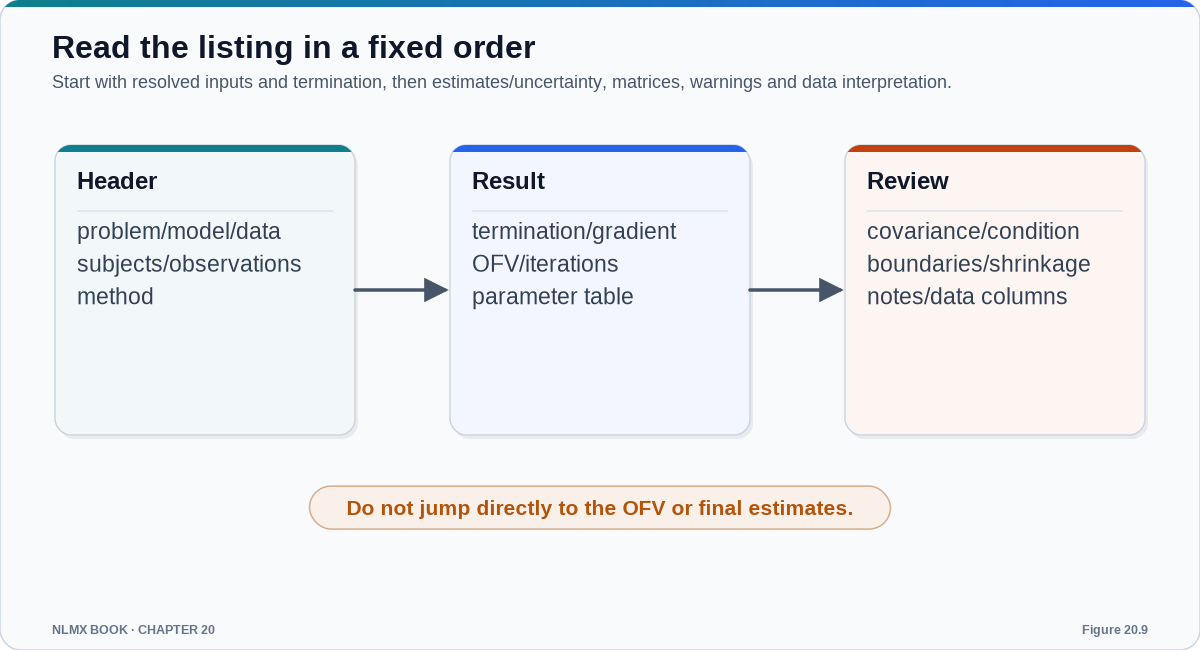
Read fit_summary.txt in a fixed order. The first question is not “what is the OFV?” but “did the intended problem run?” Confirm the problem title, resolved control stream and dataset, subject and observation counts, structural model, numbers of THETAs/ETAs/EPSs, and estimation method. A plausible answer from the wrong data is still wrong.
Next read Termination, iteration and objective-evaluation counts, and the final maximum gradient. “MINIMIZATION SUCCESSFUL” means the optimizer met its criterion; it does not certify biological plausibility, identifiability, an adequate likelihood, or a global optimum. An iteration-limit result is not made acceptable because its OFV happens to be close to another run. Compare the maximum gradient with the printed tolerance and investigate a large value.
Read the initial and final OFV together. The final value is useful for nested-model comparisons only when the data, likelihood, method and handling rules are comparable. For SAEM, the trace objective is explicitly not the reportable likelihood; use the importance-sampling OFV. Never compare an FOCE-I OFV with a SAEM trace value.
Then review every parameter row: estimate, fixed status, standard error, RSE, confidence interval, derived variability and shrinkage. Check signs, units and bounds. A tiny additive-error estimate at its lower bound can make its standard error meaningless even when the run converged. Read the complete OMEGA and SIGMA matrices, not merely their diagonals; a covariance is not a correlation.
Finally inspect covariance diagnostics, condition numbers, boundary notes, excluded predose counts and the $INPUT position map. Follow the listing into predictions.csv, plots, parameters.csv, and the final control stream. This reading order separates computational convergence from scientific adequacy.
A useful review annotation
For formal review, record four independent conclusions: input identity, minimization status, covariance status, and model adequacy. “Converged; covariance successful; diagnostics acceptable” is more informative than “run successful.” Preserve unresolved notes as review findings rather than hiding them in prose.
Common mistakes
- Looking only at OFV and parameter estimates.
- Treating missing standard errors as zero uncertainty.
- Reporting a boundary estimate without the accompanying warning.
- Assuming optimizer convergence proves that predictions are unbiased.
- Copying rounded listing values when machine-readable CSV/JSON values exist.
Checklist
- Verify problem, inputs, counts, model and method.
- Verify termination, gradient and evaluation counts.
- Distinguish minimization from covariance success.
- Review estimates, matrices, uncertainty, shrinkage and boundaries.
- Reconcile all notes with data and plots.
Further reading
Continue with the FOCE-I worked example, output bundle map, and nonconvergence guide.