19.3 Conditional target and complete-data objective
For subject \(i\), the MCMC target is proportional to \(\exp[-J_i(\eta)/2]\), where \(J_i=J_i^y+\eta^{\mathsf T}\Omega^{-1}\eta\). \(J_i^y\) contains observation likelihood contributions; the second term is the normal ETA prior penalty.
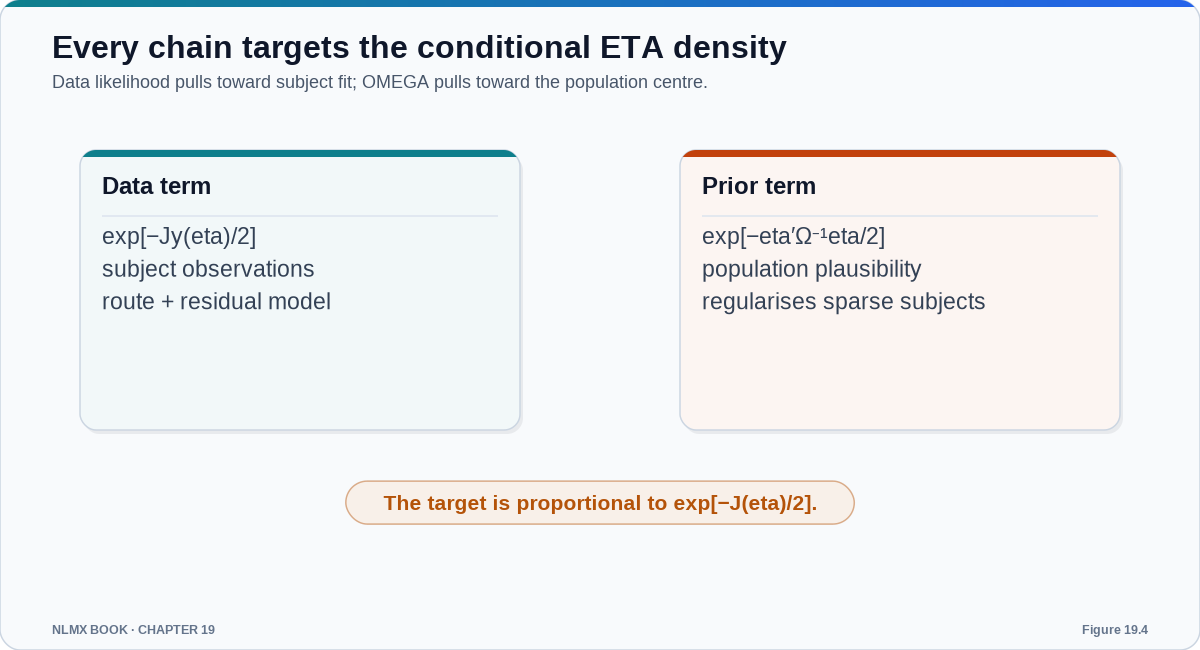
The conditional density changes whenever THETA, OMEGA or SIGMA changes. SAEM therefore evolves chains while parameters evolve. Warm continuity helps, but adaptation and burn-in are essential.
The prior-proposal kernel has a special acceptance ratio involving only \(J^y\) because its proposal distribution is the ETA prior; prior terms cancel in the Metropolis–Hastings ratio. Random-walk kernels use the full \(J\) because their proposals are symmetric.
For censored/user likelihood records, \(J^y\) uses F_FLAG contributions exactly as Chapter 18 defines them. SAEM can therefore sample general conditional likelihoods without Gaussian linearization.
Practical interpretation
For a one-ETA subject, tabulate \(J^y\), the prior penalty and total \(J\) across an ETA grid. The data-only curve controls prior-proposal acceptance after cancellation; total J controls symmetric random walks. Implement both ratios independently and verify detailed balance numerically on a toy target. This small test catches sign, factor-of-two and prior-double-counting errors before population models obscure them.
Also test an F_FLAG=1 probability record where Jy is known analytically. Confirm the same target is used consistently by all kernels and subsequent importance weights.
Common mistakes
Do not omit the ETA penalty from random-walk acceptance, include it twice for prior proposals, or assume the target stays fixed through SAEM. A conditional target is subject-specific even under shared population parameters.
Checklist
- Verify \(J^y\) record contributions.
- Verify OMEGA prior and active ETA order.
- Test acceptance ratios independently.
- Handle nonfinite likelihoods explicitly.
- Monitor target changes through burn-in.
Further reading
Proceed to chains and the three kernel pages.