42.2 The validation lifecycle: plan, seal, execute, report
What you will learn
- Follow the seven stages from requirements to maintained validated state, and the folder that holds each.
- Explain why the package is sealed before execution and what the runner does when it is not.
- Assign the roles: who writes, who executes, who approves.
- Estimate the time and disk a full run needs.
Prerequisites: 42.1 What validation covers.
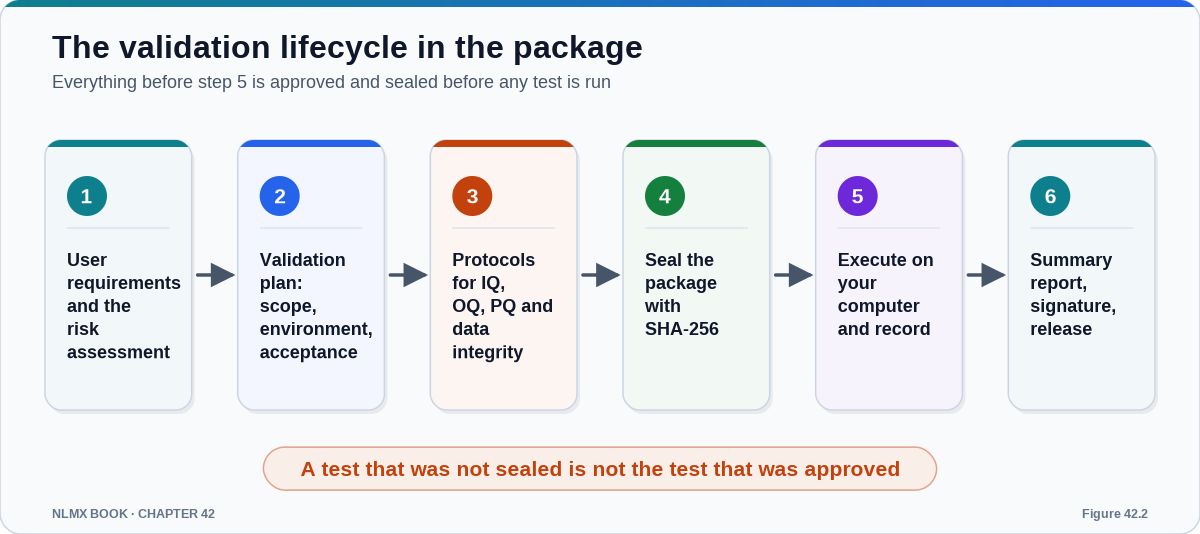
The package arrives as a folder, CFR_VALIDATION, whose numbered sub-folders mirror the order of the work. Reading the folder names top to bottom is reading the lifecycle.
 requirements (02)  ─►  risk (03)  ─►  plan (01)  ─►  protocols (04 IQ, 05 OQ, 06 PQ, 07 DI)
                                                              │   sealed: approved before use
 traceability (08) ◄── every requirement ↔ at least one test │
                                                              ▼
                  execution on your computer ─► records (10_results/) ─► deviations (09_templates/)
                                                              │
                          summary report ─► QA approval and signatures ─► release for use
The stages
| Stage | Folder | Output | Who |
|---|---|---|---|
| 1. Requirements | 02_requirements/ |
requirements.csv (controlled source), URS.md (readable form), Part 11 assessment |
validation lead, QA |
| 2. Risk assessment | 03_risk_assessment/ |
risk register that fixes test depth per area | validation lead, QA |
| 3. Plan | 01_governance/ |
validation plan, roles and training, four SOP templates | validation lead, system owner, QA |
| 4. Protocols | 04_IQ/ … 07_data_integrity/ |
testcases.json and a generated PROTOCOL.md per area |
validation lead |
| 5. Seal | package root | PACKAGE_MANIFEST.sha256 |
validation lead |
| 6. Execute and record | 10_results/ |
run folders, execution records, deviation reports | tester |
| 7. Report and release | 09_templates/ |
summary report, signature page | validation lead, QA |
The traceability matrix (08_traceability/) is generated, not written: build_rtm.py reads the requirements and every testcases.json and refuses to finish if any requirement has no test. In this edition it lists 90 requirements and 118 test cases.
Why the seal matters
When the plan and protocols are approved, seal_package.py --seal writes the SHA-256 of every controlled file into PACKAGE_MANIFEST.sha256. From then on:
- the runner refuses to execute a package that differs from its seal, so the tests that run are the tests that were approved;
- the single escape hatch,
--allow-modified, is itself recorded as a deviation; - any change to a test, a reference data file or an expected value—"even a comma"—changes the seal and goes through change control.
Think of the seal as the package's own checksum list: the same tamper-evidence idea the program applies to its outputs (page 42.13), applied to the tests.
Roles
Testers execute and sign; they do not approve their own validation. The package templates separate four signatures: author (validation lead), system owner (agrees intended use and scope), quality assurance (approves), and tester (executes). Training records are part of the deliverables because the people who use the system are part of the controls.
What one full run costs
The package README records a supplier reference run so you can plan:
| Item | Figure |
|---|---|
| Tests run | 118 (IQ 8, OQ 96, PQ 3, DI 11) |
| Elapsed time on the supplier's two-core machine | 5 min 28 s (IQ 1 s, OQ 124 s, PQ 45 s, DI 157 s) |
| Allowance for a laptop | 10–20 minutes |
| Disk for the results of a full run | about 0.5 GB (451 MB measured) |
| Software needed | Python 3.8 or newer (standard library only) and the executable under test |
| Network | none |
The supplier's run passed 112 automatic tests and left 6 pending, because they need a human judgement: the recorded origin of the executable (IQ-003, IQ-008) and four visual or real-model reviews (OQ-ASK-004, OQ-CUS-003, OQ-EDA-003, OQ-REP-003). Pending is not failed—but pending is not passed either, and the summary report lists them separately (page 42.16).
That run is evidence about the package, not about your installation. Your own run on your own computer is the validation.
A timeline, from decision to release
A realistic first-time schedule for one site:
- Day 1. Read the URS and risk register; add site-specific requirements (page 42.3); adjust severities to the intended use (42.4).
- Day 2. Complete the validation plan: intended use, environment table (computer, operating system, executable and its SHA-256, tester, date), acceptance criteria. Route for approval.
- Day 3. Rebuild the traceability matrix and protocols (
build_rtm.py,build_protocols.py), re-seal under change control, and archive the sealed manifest. - Day 4. Execute on the qualified computer: a few minutes of computer time, then the manual tests.
- Day 5. Verify the results folder, write the summary report, close deviations, sign.
Most of the calendar time is approval, not computation. The 5½ minutes of test execution is the cheap part; the value is in having asked, before running, what a pass would mean.
Review checklist
- Is the sealed manifest hash recorded in the validation plan?
- Does the environment table name the executable by SHA-256, not only by version?
- Are the six manual tests assigned to a named tester with a date?
- Is there a separate approver for every signature?
Navigation
See the previous page, the next page and the complete validation reference.