30.11 Failures and power denominators
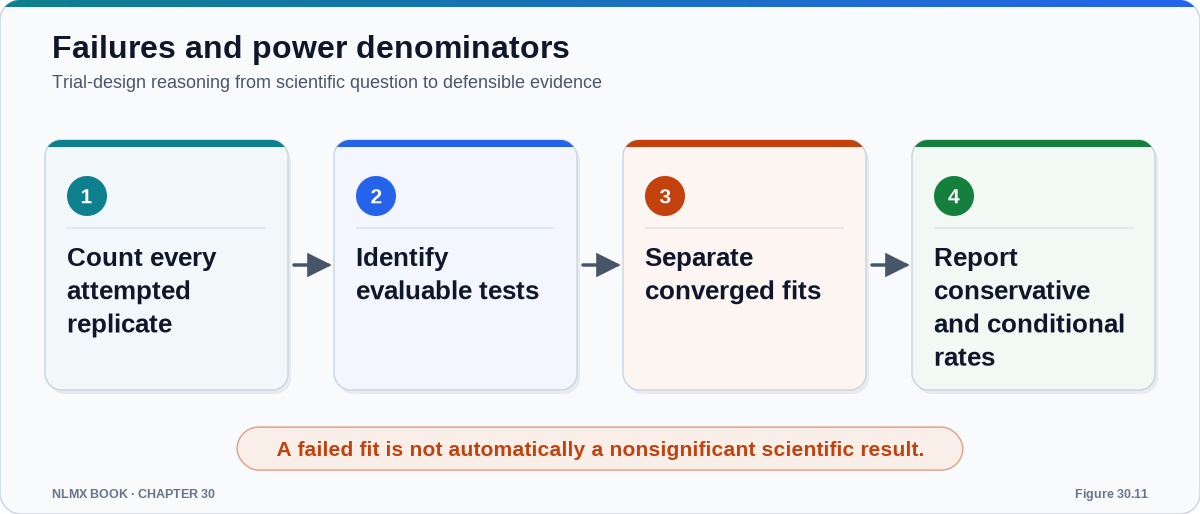
Nonlinear mixed-effects estimation can fail, converge to an unusable solution, or produce a test that cannot be evaluated. There is no universally correct way to collapse those states into one power number. nlmx therefore exposes attempted trials, evaluable tests, converged subsets, and a conservative all-trials rate.
Concepts to keep separate
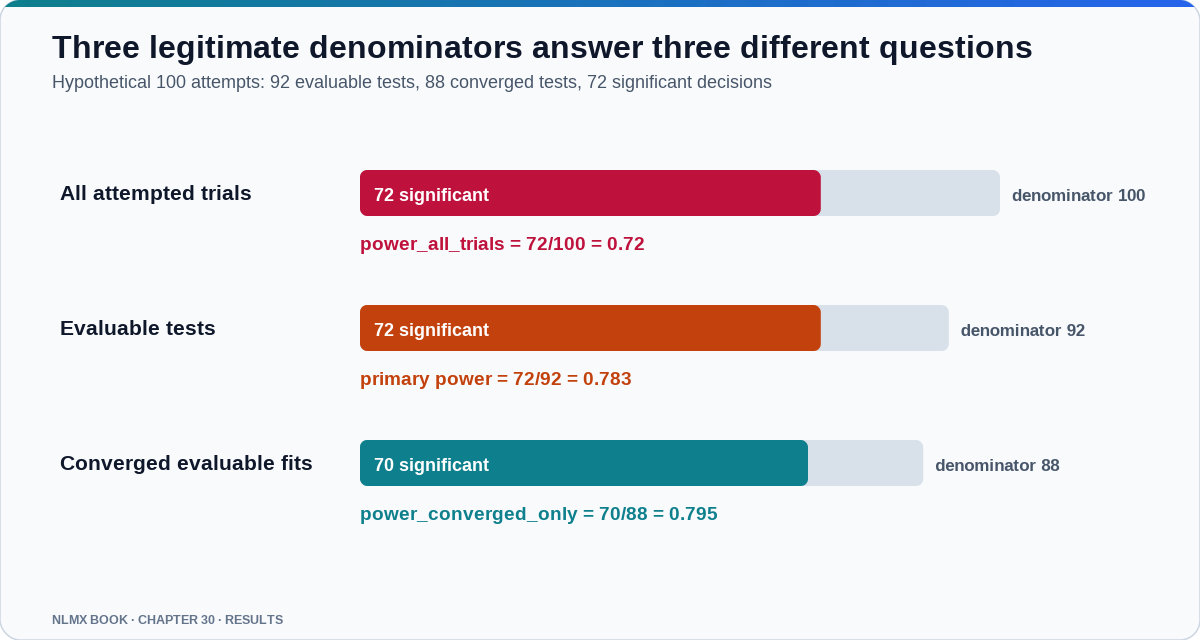
- Primary power divides significant decisions by trials in which the selected test could be evaluated.
- power_all_trials divides the same significant count by all attempted alternative trials, treating failures as non-significant.
- power_converged_only restricts the denominator to converged replicates whose selected test is evaluable.
- Convergence percentage is a separate operating characteristic and should be judged against its own threshold.
Terminology matters because a single scenario can contain several denominators and several sources of randomness. Truth is the parameter vector used to generate a replicate. Estimate is the value recovered from that replicate. Design is the planned arrangement of subjects, arms, doses, and observations. Method is the approximation or simulation–estimation procedure used to predict performance. A credible report labels all four.
Mathematical or operational walkthrough
In the figure’s hypothetical example, 72 significant results among 92 evaluable tests gives 0.783, while 72 among 100 attempts gives 0.72. Neither number should be silently substituted for the other. The gap itself diagnoses pipeline fragility.
For novices, read every expression from the inside out: identify the scientific effect, identify the null value, put both on the same parameter scale, identify the variance or information that belongs to the actual design, and only then calculate a test statistic or sample size. Units and parameterisation should cancel in a way that leaves a dimensionless statistic.
How this maps to nlmx
The executed Chapter 30 smoke run had 20 completed and 20 converged trials at each N, so all three rates coincided. This convenient result should not be assumed for harder models.
Chapter 30 explains the statistical and implementation concepts. Chapter 31 gives the complete nlmx power command, every CLI and settings control, precedence, output schema, and production workflow. This separation is deliberate: choosing an option correctly requires understanding which estimand and assumption it changes.
Quality-control checklist
- Are attempted, completed, failed, and evaluable counts printed?
- Is the denominator stated beside every power estimate?
- Are failure reasons retained?
- Is convergence included in the acceptance rule?
The graph is explanatory; the CSV, JSON, resolved settings, model inputs, and replicate rows are the authoritative evidence. When a plotted point looks surprising, diagnose the underlying rows before changing the design.
Common mistakes
- Deleting failed trials before aggregation
- Calling all failures nonsignificant without also reporting evaluable power
- Equating completed with converged
Also avoid copying a sample size from a nearby project. Power is conditional on the model, tested effect, covariate distribution, schedule, residual and random variability, attrition, test, estimator, and success criteria. Similar-looking studies can have very different information.
Evidence to retain
- scientific question, estimand, hypothesis, alpha, target, and criteria;
- model/data/design inputs, parameter source and uncertainty distribution;
- software version, method, approximation, seed, threads, command, and resolved settings;
- scenario grid, row-level results, failures, denominators, intervals, diagnostics, and checksums;
- scripts that calculate derived tables and figures, plus the interpretation and limitations.
Navigation
See the previous page, next page, and formula and decision index.