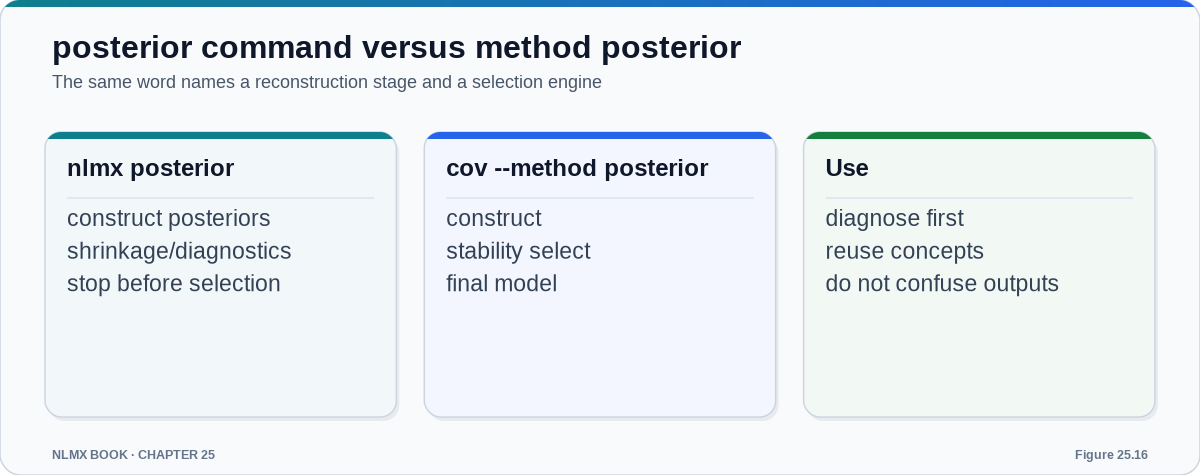
nlmx posterior versus cov --method posterior
nlmx posterior reconstructs or ingests subject posterior means/covariances, computes shrinkage and consistency diagnostics, writes the posterior-stage outputs, and stops. It does not run stability selection, classify relationships, or create a selected final covariate model. This is ideal for diagnosing PHI/ETC quality or reconstruction before an expensive schedule.
nlmx cov --method posterior performs the same posterior preparation and continues into features, resampling/draws, learners, classification, error control, and final joint refit. The shared parser displays many covariate options for both commands, but selection-only controls have no effect when the standalone posterior command stops early.
Name output directories accordingly—such as posterior_stage versus cov_posterior—and never interpret a posterior summary as a selection result. The chapter preserves a real standalone reconstruction command and its console output for this distinction.
Common mistakes
- Changing the scientific question after seeing the result while presenting it as the original run.
- Reading one engine's summary without checking its prerequisites, failures, normalized settings, and fitted endpoint.
- Treating a generated draft, comparison label, or completed checkpoint as a substitute for model diagnostics and reference-software confirmation.
Page checklist
- The exact command, version, inputs, resolved settings, and output directory are identifiable.
- Engine-specific evidence is interpreted on its own scale before cross-method comparison.
- Recovery state, final refit, diagnostics, and remaining confirmation work are explicit.