17.5 Candidate set and parent hierarchy
The candidate set should be an explicit protocol, not a catalogue of everything the software can generate. --compartments, --absorption, --lag, --tmdd, --error, and --eta define broad families; --models narrows the run to named candidates. Names encode disposition, input, timing, and elimination—for example, 2cmt_abs_lag or 1cmt_noabs_mm.
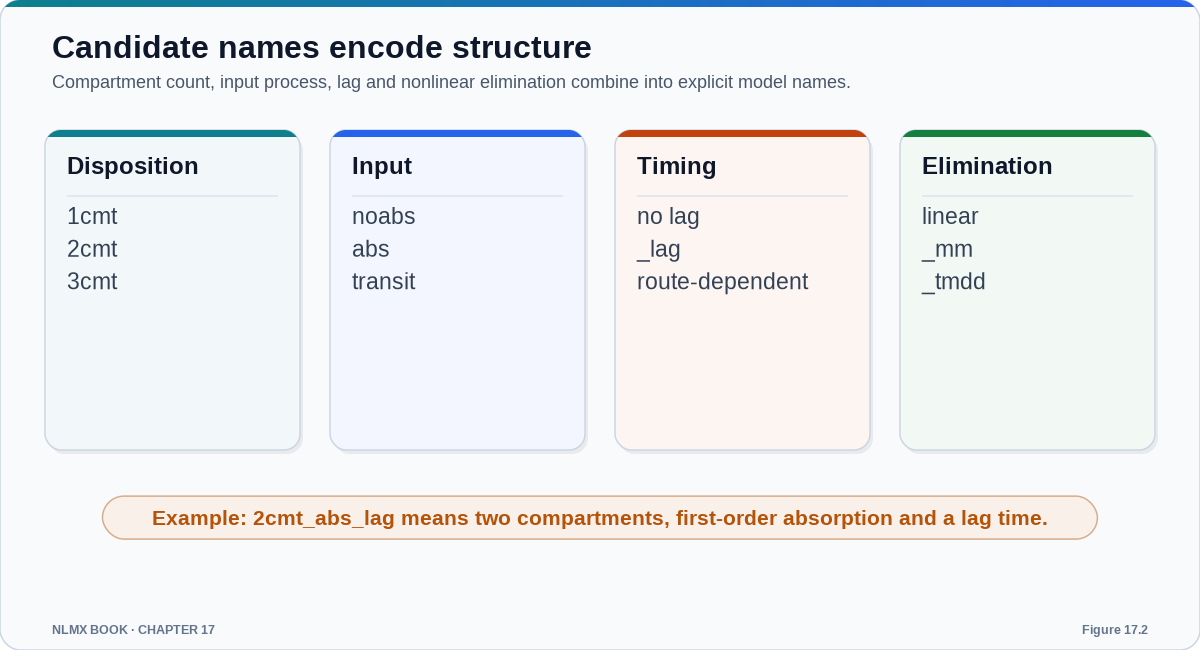
screen uses a parent hierarchy so complexity is introduced gradually. A one-compartment fit can seed a two-compartment model; that fit can seed a three-compartment model. A no-lag model can seed its lag counterpart. Nonlinear elimination can inherit disposition estimates from the linear parent. Parameters newly introduced by the child receive structure-specific starts.
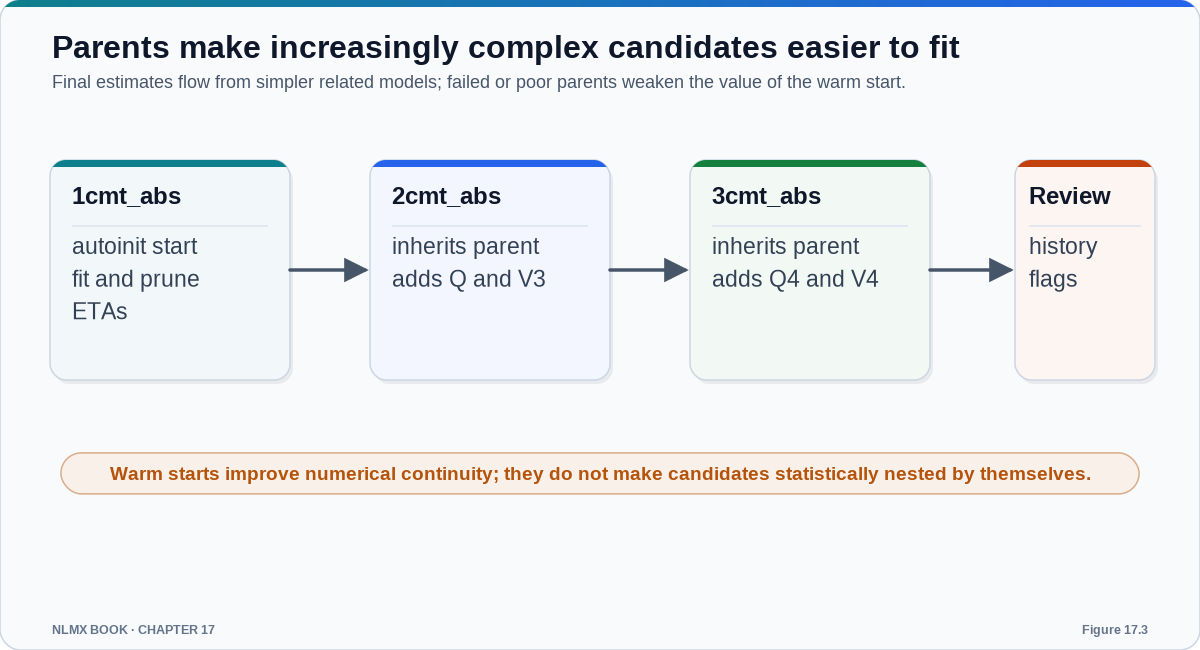
This hierarchy improves numerical continuity and makes the history interpretable. It does not make arbitrary pairs nested for a likelihood-ratio test. Statistical nesting requires that the reduced model be obtainable as a parameter restriction of the full model, with compatible likelihood and data. The program’s lrt_tests.csv records recognized edges; do not invent an LRT from similar names alone.
Order also creates dependence: a poor parent solution can provide a poor warm start. Review the “initial values used” section and consider a sensitivity fit from alternative starts when the child fails or lands at a boundary.
Common mistakes
Avoid screening lag, transit, three compartments and TMDD simultaneously without design support. Do not assume a child is invalid merely because the parent failed, or valid merely because it inherited a parent. Do not compare models with different residual likelihoods as if only structure changed.
Checklist
- Write the scientific rationale for every family.
- Freeze the explicit candidate names.
- Check recognized parent and LRT relationships.
- Record the start source for each candidate.
- Investigate failures with alternative starts before excluding a plausible model.
Further reading
See the individual family pages compartments, lag, transit, and TMDD.