15.22 Parameter columns: steady state, accumulation, flags, and skipped profiles
Steady-state fields are present in the common schema and populated only when the profile and tau support them.
| Column | Meaning |
|---|---|
AUCTAU, AUMCTAU |
Area and first-moment area over tau. |
CTAU |
Concentration at the interval boundary. |
CAVG |
AUCtau/tau. |
FLUCT_PCT |
Percentage fluctuation around Cavg convention. |
SWING, PTR |
Swing and peak-to-trough ratio when Cmin permits. |
CL_SS, CL_F_SS |
IV or apparent interval clearance. |
VZ_SS, VZ_F_SS |
Terminal volume based on interval exposure. |
MRT_SS, VSS_SS |
Steady-state residence time and IV volume when valid. |
RACC_PRED |
Lambda-z-based predicted accumulation. |
RACC_AUC, RACC_CMAX |
Observed accumulation comparisons when matching intervals exist. |
Flags
FLAGS is a space-separated list of diagnostics. Examples include back-extrapolated C0, area starting at the first sample, short lambda-z span, excessive extrapolation, or AUCinf attempted after earlier doses. Flags explain limitations; they do not necessarily remove values.
The exact set can grow with software versions. Code consuming the file should treat flags as a token list and preserve unknown tokens rather than filtering to a hard-coded catalogue.
Skipped profiles
SKIPPED contains the reason a constructed profile could not be analysed—for example, too few usable observations. A skipped row is evidence that a dose interval existed. Count it in disposition summaries, but do not coerce blank parameters to zero.
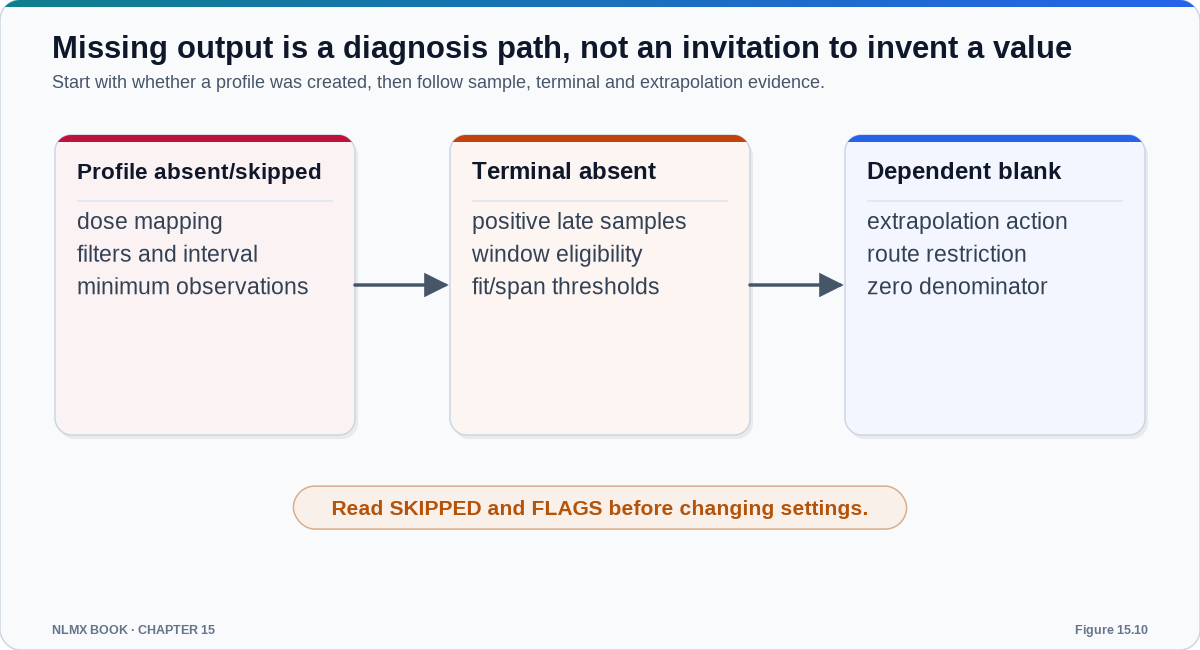
Separate three conditions: no profile was constructed, a profile row was skipped, or a profile was analysed but a dependent parameter is blank. Each has a different diagnostic path.
Common mistakes
- Interpreting blank steady-state fields on single-dose rows as errors.
- Splitting FLAGS on commas instead of whitespace.
- Converting skipped blank values to zero in downstream software.
- Reporting only analysed profiles without disposition counts.
Checklist
- Confirm
STEADY_STATEand tau before reading interval metrics. - Parse and preserve all flags.
- Tabulate skip reasons.
- Distinguish profile absence, skip, and parameter blank.
- Carry diagnostics into summaries and review listings.
Further reading
See analysis interval controls, troubleshooting, and steady-state theory.