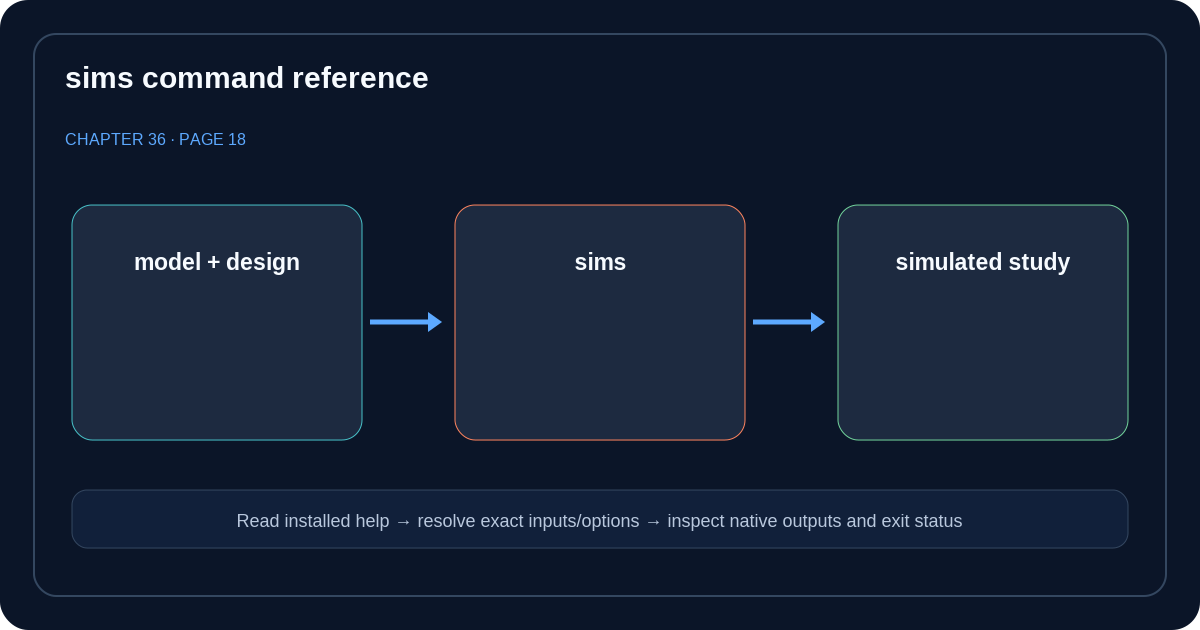
This chapter is a lookup reference for nlmx 4.16.1. Option tables are generated from the installed release executable. Read an option in the context of the command page: nlmx uses a global parser, but an accepted option can be irrelevant to a command unless its help text names that command or the command's method chapter defines the behavior.
The safe sequence is: identify the installed version, open that command's help, freeze input/settings/output paths, run into a new or empty output directory, inspect both the process status and the command-native verdict, and retain the log/resolved settings/checksums. A command line is reproducible only when its referenced files and software version are also frozen.
Synopsis
nlmx sims [OPTIONS] [CONTROL_STREAM]
Required context. A NONMEM control stream and parameter source, with either an observed design dataset or generation settings for subjects, dosing, sampling, covariates, and groups.
What it does. Simulates full studies including random effects/residual error and computes individual steady-state exposure metrics and summaries.
Principal outputs. Simulated dataset(s), subject exposure metrics, group/target summaries, plots, report, simulation settings, log, and checksums.
Positional arguments shown by installed help
[CONTROL_STREAM]
          Control stream (.ctl/.mod) of the model to simulate; same as --ctl
Start with installed help and, when available, generate the complete settings template before entering study choices. Run into a new or empty output folder. After completion, review the command's native summary/verdict, warnings, logs, resolved settings, and checksum manifest—not only the console's final line.
Complete installed option reference
The following 110 options are parsed directly from nlmx 4.16.1 sims --help. The unmodified txthelp snapshot and its SHA-256 are preserved in the jsonhelp inventory. Shared descriptions sometimes mention several commands; apply only the clause naming sims unless its method chapter specifies otherwise.
Options
Option
Installed description
-h, --help
Print help
Method
Option
Installed description
--threads <THREADS>
Worker threads for subject- and replicate-level parallelism (default: all cores). Results do not depend on this value
Input selection
Option
Installed description
--ctl <CTL>
Control stream (.ctl/.mod)
--ext <EXT>
Final estimates (.ext); sims: the parameter values of --estimates final; power: the final estimates (default: those of the control stream)
--cov <COV>
Parameter covariance matrix (.cov); sims: with it every simulation of the study uses a new parameter set (parameter uncertainty); power: needed for --uncertainty
--data <DATA>
Analysis dataset (overrides $DATA); sims: simulate this dataset instead of generating one
Core
Option
Installed description
-c, --config <FILE>
Settings file of the command (TOML syntax), with the command's extension: .covar (cov, posterior, inspect, validate, fit), .qcd, .qcn, .eda, .nca, .init, .screen, .vpc, .forest, .sims, .er, .power, .gen, .ask
-o, --output <OUTPUT>
Output directory
--run-dir <RUN_DIR>
Existing run directory, for resume
--overwrite
Allow writing into a non-empty output directory
--dry-run
Run the validation pipeline instead of the full analysis
--no-checkpoint
Do not write replicate checkpoints (posterior engine)
0 (default) prints progress to the terminal; 1 silences it (the log is still written)
--log-file <LOG_FILE>
Write the transcript here instead of log_<id>.txt
--no-color
Disable ANSI colour
--license
Print the license (CC BY-ND 4.0), the third-party components, how long this version may be used and how to contact the author, and stop
-v, --verbose...
Increase verbosity (repeatable: info -> debug -> trace)
-q, --quiet
Errors only on the terminal (the log file is unaffected)
--keep-subject-ids
Do not hash subject identifiers in outputs
--format <FORMAT>
Output format for schema: txt | toml | json | json-schema [default: txt]
Generate and simulation study
Option
Installed description
--subjects <SUBJECTS>
generate, simulate-study: subjects in total (generate: split evenly over the groups unless
--subjects-per-group is given)
--n-doses <N>
generate: doses per subject (default 1; ADDL = N - 1); sims: number of doses, the last interval is analysed (default 1)
--infusion-duration <H>
generate: infusion duration in hours for --route infusion (default 1); sims: infusion time in hours (0 = bolus or oral; needs a RATE item in $INPUT)
--sample-times <LIST>
generate: sampling times (h after each sampled dose), comma separated (default by structure and route); sims: sampling times in hours after the last dose (default 12 times over the interval)
Fit
Option
Installed description
--stem <STEM>
fit: file stem for the NONMEM-format outputs (default: the control stream's stem)
VPC
Option
Installed description
--lloq <VALUE|COLUMN>
vpc, autoinit, screen: lower limit of quantification (vpc: a number or a data column; autoinit, screen: a number); values below it are censored / left out
--no-caption
vpc, fit, autoinit, screen: no grey caption (check, observations, date) under the charts
--param-uncertainty
vpc: simulate with parameter uncertainty: a new THETA/OMEGA/SIGMA draw from the .cov for every replicate
--param-file <FILE>
vpc: parameter sets (CSV with THETA1.., OMEGA(1,1).., SIGMA(1,1).. columns, e.g. bootstrap results) used one per replicate; implies --param-uncertainty
--no-plots
vpc: tables only; no HTML report or report SVG files
--no-svg
vpc, fit, autoinit, screen: write no SVG files at all (neither svg/ nor plots/svg/); PNG plots and the HTML report are unaffected
--print-config <FILE>
write the command's annotated settings template to FILE (with the command's extension, e.g. nlmx.eda, nlmx.vpc) and exit
NCA
Option
Installed description
--auc-method <RULE>
nca: trapezoid rule: linear | linear-log | linear-up-log-down (default)
--partial-auc <LIST>
nca: partial areas, e.g. 0-4,0-12,4-12 (times after the dose)
--steady-state <MODE>
nca: which intervals are at steady state: auto (SS = 1 records; default) | none | last | all
--tau <H>
nca: dosing interval tau when the data have no II
Sims: exposure metrics
Option
Installed description
--conc-variable <NAME>
sims: the model variable that holds the concentration for the exposure metrics, e.g. IPRED (default: F)
Sims: dosing and sampling
Option
Installed description
--ss-doses <N>
sims: doses given to reach steady state when $INPUT has no SS item (default 20)
--dose <MG>
sims: dose in mg per subject (default 100)
--dose-per-kg <MG/KG>
sims: dose in mg per kg of body weight
--dose-levels <LIST>
sims: one arm per dose level, e.g. 50,100,200 (subjects per arm: --subjects)
--weight-bands <BANDS>
sims: dose by weight band, "from-to:dose" separated by commas, e.g. 0-20:50,20-40:100,40-250:200
--dose-min <MG>
sims: smallest dose given
--dose-max <MG>
sims: largest dose given (a cap for weight-based doses)
--dose-round <MG>
sims: round the dose to a multiple of this amount
--dose-rate <RATE>
sims: value of RATE (-1 and -2 for a modelled rate or duration); replaces
--infusion-duration
--dose-cmt <N>
sims: compartment that receives the dose (default 1)
--sample-relative-to <REF>
sims: the sampling times are measured from the last-dose (default) | first-dose
Sims: input and population
Option
Installed description
--estimates <MODE>
sims: which parameter values are simulated: auto (the control stream's $SIMULATION decides) | initial | final (needs --ext)
--cdc-table <FILE>
sims: weight-for-age table in the CDC layout (Sex, Agemos, L, M, S) replacing the built-in CDC 2000 reference
--weight-col <COLUMN>
sims: $INPUT item that holds the body weight (default: WT, BW, BWT, WGT, WEIGHT)
--age-col <COLUMN>
sims: $INPUT item that holds the age (default: AGE, AGEY, AGEYR)
--sex-col <COLUMN>
sims: $INPUT item that holds the sex (default: SEX, GENDER, GNDR)
--arm-col <COLUMN>
sims: $INPUT item that numbers the arms (default: ARM, TRT, COHORT, GROUP)
--population <KIND>
sims: who is simulated: adult | pediatric | mixed (default adult)
--pediatric-fraction <FRACTION>
sims: share of pediatric subjects of a mixed population (default 0.5)
--pediatric-age <MIN-MAX>
sims: pediatric age range in years, e.g. 2-20 (default 2-20; the CDC weights cover 2 to 20)
--pediatric-weight <SOURCE>
sims: how the pediatric weight is drawn: cdc (default) | normal | lognormal
--adult-age <MIN-MAX>
sims: adult age range in years (default 18-80)
--adult-age-mean <YEARS>
sims: mean adult age in years (default 45)
--adult-age-sd <YEARS>
sims: standard deviation of the adult age in years (default 15)
--adult-weight-mean <KG>
sims: mean adult body weight in kg (default 70)
--adult-weight-cv <CV>
sims: coefficient of variation of the adult weight: a fraction (0.15) or a percentage (15%) (default 0.15)
--adult-weight-sd <KG>
sims: standard deviation of the adult weight in kg, instead of the coefficient of variation
--adult-weight-range <MIN-MAX>
sims: lowest and highest adult weight in kg (default 35-250)
--female-fraction <FRACTION>
sims: share of females, both groups (default 0.5)
--sex-codes <MALE,FEMALE>
sims: codes of males and females in the sex column (default 0,1)
--sex-sampling <MODE>
sims: sex assignment: random (default) | balanced
--cdc-z-limit <SD>
sims: limit of the CDC z-score of the pediatric weights (default 3)
sims: number of simulations of the whole study (NONMEM SUBPROBLEMS; default: $SIMULATION, else 1)
--sim-etas <MODE>
sims: random effects: sample (default) | zero (typical subject)
--sim-eps <MODE>
sims: residual error: sample (default) | zero
--omega-scale <FACTOR>
sims: multiply OMEGA by this factor (default 1)
--sigma-scale <FACTOR>
sims: multiply SIGMA by this factor (default 1)
--set-theta <LIST>
sims: replace THETA values, e.g. 1=3.2,4=0.5
--table-vars <LIST>
sims: model variables written next to the simulated values, e.g. CL,V,KA (default: the items of $TABLE). custom: the columns a summary / demographics / correlation table describes
--no-table-record
sims: ignore the items of the control stream's $TABLE record
--blq-action <ACTION>
sims: simulated values below --lloq: none (default) | flag (both keep the values and mark them in the column BLQ) | set-lloq (values become the LLOQ) | drop (the observations are removed); power: drop (default) | half | set-lloq
Sims: metrics and summary
Option
Installed description
--metrics <LIST>
sims: metrics to compute, e.g. CMAX,TMAX,CMIN,CTROUGH,CAVG,AUCTAU,FLUCT,SWING,PTR,CLSS
--no-metrics
sims: do not compute the exposure metrics
--metric-profile <SOURCE>
sims: profile of the metrics: dense (default; the model on a fine grid) | sampled | observed
--metric-interval <WHICH>
sims: dosing interval analysed: last (default) | first | the number of the dose
--grid-points <N>
sims: points of the dense grid over the interval (default 241)
--trough-time <HOURS>
sims: time after the dose at which CTROUGH is read (default: the end of the interval)
--conc-at <LIST>
sims: concentrations at these times after the dose, e.g. 2,6 (columns C_2H, C_6H)
--dose-normalize
sims: also divide the metrics by the dose
--summary-by <COLUMNS>
sims: summarise by these subject columns, e.g. ARM,SEX,AGEGRP
sims: also summarise by the crossing of all --summary-by columns
--age-bins <LIST>
sims: age groups (column AGEGRP) from cut points in years, e.g. 2,6,12,18,100
--weight-bins <LIST>
sims: weight groups (column WTGRP) from cut points in kg, e.g. 0,20,40,60,250
--targets <LIST>
sims: target ranges, e.g. CAVG:10-50,CMIN:>=5,CMAX:<=100; the share of subjects in range is reported
--digits <N>
sims: significant digits of the summary tables (default 4)
Sims: figures and output
Option
Installed description
--boxplot-metrics <LIST>
sims: metrics drawn as box plots, or none (default CMAX,CMIN,CAVG,AUCTAU)
--boxplot-by <COLUMN>
sims: column on the x axis of the box plots (default: the first --summary-by, else ARM)
--scatter <LIST>
sims: scatter plots "X:Y", e.g. WEIGHT:AUCTAU,AGE:CMAX, or none
--smoother <KIND>
sims: smoother of the scatter plots: loess (default) | linear | none
--no-profile-plot
sims: no concentration-time plot
--profile-scale <SCALE>
sims: scale of the concentration-time plot: linear (default) | log | both
--write-profiles
sims: also write the concentration-time profile of every subject, as the metrics use it (large when dense)
--write-nonmem-table
sims: also write the simulated dataset as a NONMEM table (TABLE NO. 1)
Plots (vpc, fit, autoinit, screen, nca)
Option
Installed description
--plot-width <W>
plots: figure width in --plot-units (default 7 in)
--plot-height <H>
plots: figure height in --plot-units (default 5 in)
--plot-units <UNITS>
plots: units of width and height: in (default) | cm | mm | px
--plot-dpi <DPI>
plots: resolution in dots per inch (default 300)
--plot-base-size <PT>
plots: base font size in points (default 11, as ggplot2)
Interpretation and common failure
A seed identifies random draws only with the same version/settings. Verify design reconstruction, units, parameter source, uncertainty, covariate generation, replicate meaning, and whether written observations could be very large.
The detailed method and examples are in the relevant book chapter. Common nonzero process classes are documented on 36.35. A process exit of zero still requires command-native scientific and numerical review.
Minimal handoff record
Record the version, exact command and working directory, input/settings hashes, selected options and defaults, output path, process exit, native verdict or convergence state, warnings/exclusions, principal results with uncertainty, checksum verification, and reviewer disposition.