Posterior checkpoint lifecycle
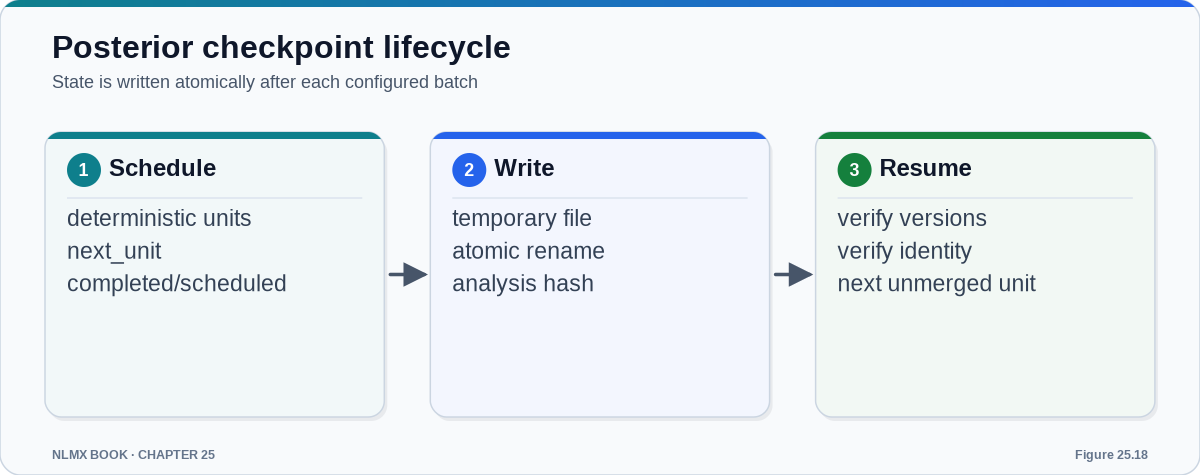
The stability schedule is divided into deterministic units. After each batch controlled by resampling.checkpoint_every, nlmx serializes the aggregation state with next unit, completed/scheduled fits, original argv, analysis hash, engine/schema/RNG versions, and complete=false. It writes a temporary file and atomically renames it to checkpoint.json, preventing readers from observing a half-written JSON object.
Resume verifies identity and continues from the next unmerged unit, so completed units are not double-counted. At normal completion, the checkpoint is rewritten with complete=true and cleared/default state; a completed checkpoint is evidence of closure, not something to resume.
Checkpoint frequency trades write overhead against recovery granularity. Very large batches lose more work after interruption; extremely small batches create more filesystem activity. Preserve the final checkpoint with outputs and test interruption/recovery on the target platform before relying on it operationally.
Common mistakes
- Changing the scientific question after seeing the result while presenting it as the original run.
- Reading one engine's summary without checking its prerequisites, failures, normalized settings, and fitted endpoint.
- Treating a generated draft, comparison label, or completed checkpoint as a substitute for model diagnostics and reference-software confirmation.
Page checklist
- The exact command, version, inputs, resolved settings, and output directory are identifiable.
- Engine-specific evidence is interpreted on its own scale before cross-method comparison.
- Recovery state, final refit, diagnostics, and remaining confirmation work are explicit.