14.22 Route-specific starts, infusion, and multiple-dose boundaries
The first integration point depends on how drug entered the body. Applying one start rule to every route is a common source of silent AUC differences.
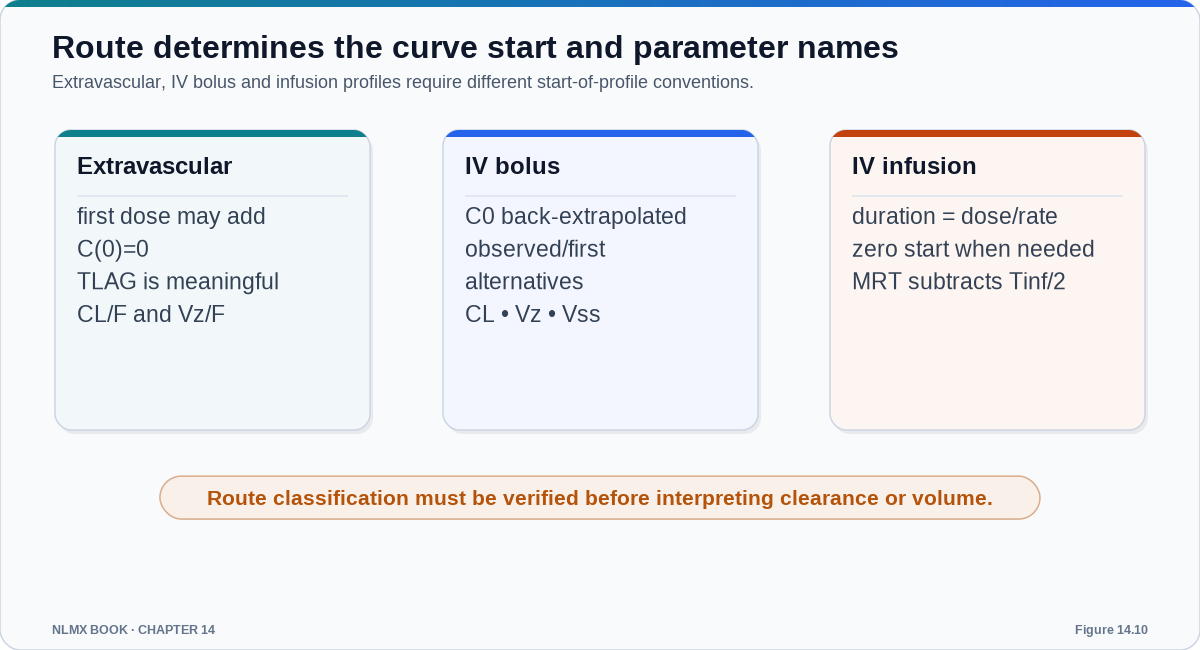
Extravascular dosing
For a first oral or other extravascular dose, nlmx can insert concentration zero at dose time when zero_at_dose is enabled. This represents no systemic drug immediately before the first dose, provided there is no baseline concentration. Predose observations before the first dose are not integrated as negative relative times. After repeated dosing, the interval begins with the observed or assigned predose concentration rather than an artificial zero.
Intravenous bolus
An IV bolus can have an unobserved concentration at time zero because the first blood sample occurs after administration. By default nlmx back-extrapolates C0 from the first two declining positive observations. If those observations do not decline or do not support a finite extrapolation, C0 should not be invented. The chosen convention—back-extrapolated, observed, or omitted—must match the reference analysis.
Intravenous infusion
Infusion has a finite input duration. Time zero concentration can be zero for a first dose, but input continues until the infusion ends. The observed maximum may occur at or after the end of infusion. MRTinf requires subtracting half the infusion duration under constant-rate input. Verify that dose time, infusion duration, sample time, and time units use the same origin.
Multiple doses
nlmx constructs a profile for each dose interval. A sample at the next dose time may close the preceding interval as its tau boundary. It should not be accidentally counted twice as two independent samples. Later-dose profiles begin from their actual interval boundary and carry residual concentration from earlier doses.
Extrapolating a later interval to infinity imagines that no next dose occurs and is usually not the primary repeated-dose summary. nlmx flags that situation. At steady state, AUCtau and interval metrics are normally preferred. Dose records, occasion variables, and actual sample times must be sorted and mapped correctly before profile construction.
Common mistakes
- Adding a zero at every dose, erasing residual concentration.
- Treating IV bolus C0 as an observed measurement.
- Omitting infusion duration from MRT interpretation.
- Counting a next-dose boundary sample twice.
Checklist
- Confirm route for every dosing record.
- Inspect the constructed time-zero or boundary point.
- Verify bolus extrapolation or infusion duration.
- Review next-dose samples and interval assignment.
- Prefer AUCtau for steady-state interval exposure.
Further reading
See profiles and time origin, AUMC and MRT, and steady-state metrics.