13.7 Covariate discovery, types, and time variation
When no explicit list is supplied, eda searches columns that are not recognized as NONMEM data items, times, visits, BLQ bookkeeping, observation types, or common design variables. Whole-number variables with few levels and text variables are treated as categorical; other numeric variables are continuous.
Automatic detection is a draft
Design names such as TAD, VISIT, DVID, DOSE, ARM, STUDY, and PERIOD are intentionally excluded from automatic covariates, though they remain available for grouping and custom outputs. A real covariate with an excluded name must be listed explicitly. Conversely, an unrecognized technical column can be incorrectly proposed as a covariate.
Use --covariates WT,AGE,SEX to choose a plain list. Do not use CL=WT, which belongs to covariate-model commands. --categorical SEX,RACE overrides classification, while [covariates].continuous can force continuous treatment and [covariates].exclude can remove columns. A column cannot be both categorical and continuous.
Baseline and time-varying values
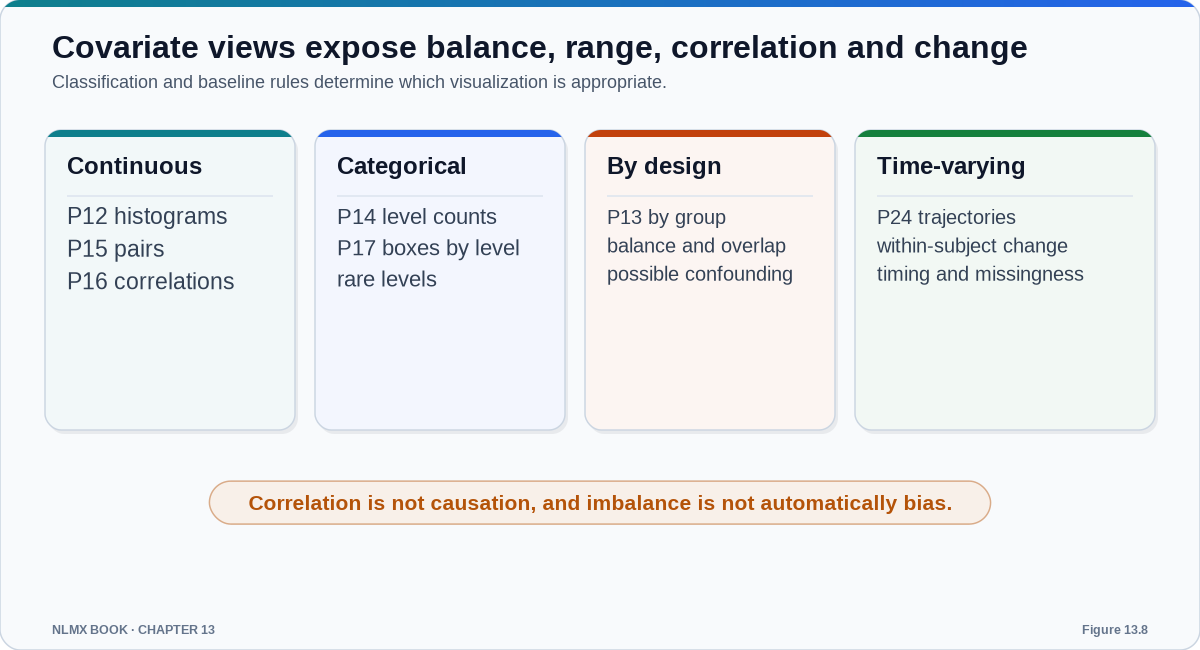
Subject-level tables use the first nonmissing baseline covariate value. Declare changing variables with --time-varying CRCL or configuration so P24 can show within-subject trajectories. Baseline summaries and time-varying plots answer different questions: a balanced baseline does not imply similar longitudinal change.
For each selected covariate, maintain a role sheet with source column, units, data type, baseline rule, expected range/levels, and whether it may change after dosing. This makes automatic detection reviewable and prevents a design identifier or derived outcome from entering the covariate set accidentally.
Common mistakes
- Accepting detected types without a data dictionary.
- Treating coded categories such as 1/2/3 as continuous.
- Calling a changing laboratory value a fixed baseline covariate.
- Including post-baseline consequences as causal baseline predictors.
Checklist
- Compare detected columns/types with the specification.
- Force categorical and continuous roles where needed.
- Identify baseline rules and time-varying variables.
- Inspect level counts, ranges, and within-subject changes.
- Record exclusions and rationale.
Further reading
See covariate standard plots, demographic tables, and covariate QC.