A.18 Hand checks, and where each formula is used
What you will learn
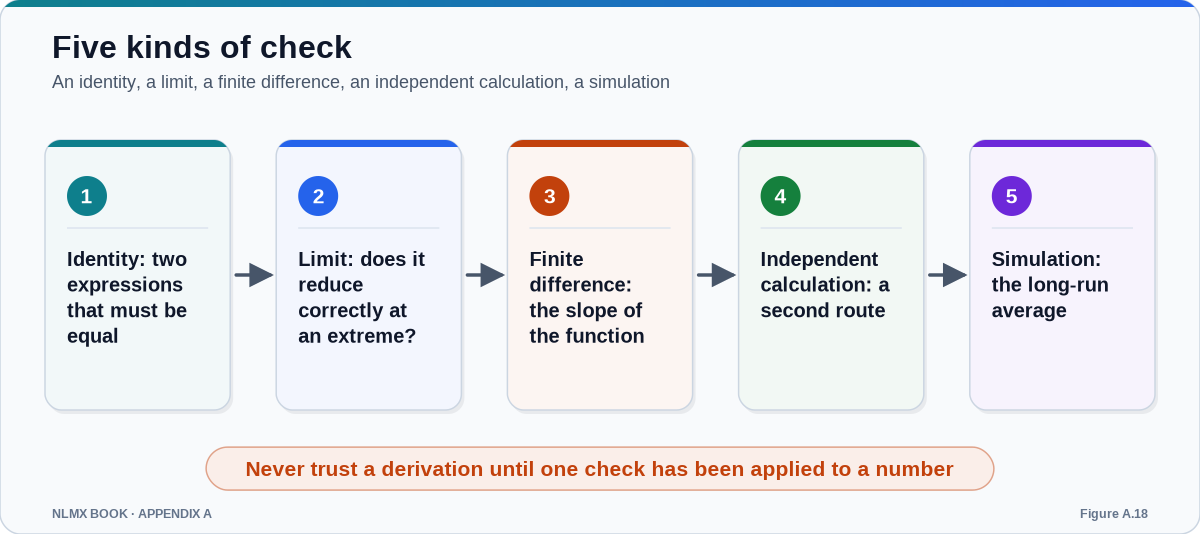
- Apply five kinds of check to any formula or number: an identity, a limiting case, a finite difference, an independent calculation and a simulation.
- Find, for each worked illustration of this appendix, the check that confirms it.
- Look up which command uses which family of equations, and the chapter that develops it.
Prerequisites: pages A.1 to A.17, as needed.
Why check by hand
A formula in a book, a number in an output and a line of code can all be wrong in different ways. A check is useful to the extent that it is independent of what it checks: the same code run twice proves nothing, while a closed form, a limiting case or a derivative taken a second way can expose an error that a test of the program would pass. The validation chapter (Chapter 42) applies the same idea to the whole program; this page applies it to individual equations.
Five kinds of check
| Check | Question it asks | Example from this appendix |
|---|---|---|
| 1. An identity | does the formula equal a second expression that must be equal to it? | the determinant lemma against a direct determinant (A.2): \(3.3616\times10^{-4}\) both ways |
| 2. A limiting case | does it reduce to the right answer when a parameter goes to an extreme? | \((e^L-1-L)/L^2\to\tfrac12\) as \(L\to0\) (A.15); the information \(n/(\sigma^2+n\omega^2)\to1/\omega^2\) as \(n\to\infty\) (A.16) |
| 3. A finite difference | does a derivative agree with the slope of the function? | the gradient \(54.8430\) against a central difference (A.3); the dual-number derivative against a difference table (A.9) |
| 4. An independent calculation | does a second route, with no shared code or steps, give the same number? | the exact integral by quadrature against the approximations (A.8); the NCA by hand against the segment table (A.15) |
| 5. A simulation | does the long-run average of simulated draws match the formula? | the importance-sampling estimate against the exact integral (A.11) |
A good habit: never trust a derivation until one of these has been applied to a number. The first three need no computer.
The worked illustrations and their checks
Every number below was recomputed with arithmetic independent of the program.
| Page | Quantity | Value | Check applied |
|---|---|---|---|
| A.1 | CV of \(\omega^2=0.09\) and \(0.50\) | 30.7 %, 80.5 % | formula evaluated directly |
| A.2 | \(\lvert C\rvert\) by the lemma, and by direct expansion | \(3.3616\times10^{-4}\) | identity (1) |
| A.2 | \(r^{\mathsf T}C^{-1}r\) by Woodbury and by solving | 3.5151 | identity (1) |
| A.3 | \(\partial J/\partial\eta\) at \(-0.2\) | 54.8430 | finite difference (3) |
| A.4 | Cholesky factor of a \(2\times2\) \(\Omega\) | \(L_{22}=0.17321\) | \(LL^{\mathsf T}\) reproduces \(\Omega\) (1) |
| A.6 | exact \(\mathrm{OFV}_i\) of the appendix subject | \(-0.8150\) | quadrature (4) |
| A.8 | FO, FOCE, FOCE-I, Laplace | \(-1.283,\ -1.602,\ -1.087,\ -0.758\) | against the exact value (4) |
| A.9 | Newton mode search | \(\hat\eta=-0.33425\) | gradient zero, curvature 251.0 (3) |
| A.9 | forward-mode derivative | \(-0.818731\) | finite differences at several steps (3) |
| A.10 | step-size average | 0.0350 | equals the arithmetic mean (2) |
| A.11 | importance-sampling \(\mathrm{OFV}_i\) | \(-0.8151\) at \(M=3000\) | exact value (4, 5) |
| A.12 | sandwich SE of a mean | 0.363 | \(\times\sqrt{n/(n-1)}\) gives the textbook 0.383 (2) |
| A.12 | delta-method SE of a ratio | 1.00 | direct expansion of the variance (1) |
| A.13 | AIC, BIC variants and weights | tables | formulas evaluated directly |
| A.14 | first outputs of the generator from a zero state | 0xE220A8397B1DCDAF |
the value commonly used as a test vector (4) |
| A.15 | \(\lambda_z\) of the 4-point window | 0.12498 | \(S_{xy}/S_{xx}\) by hand (4) |
| A.15 | \(\mathrm{AUC}_\infty\), CL/F, \(V_z\)/F | 64.935, 1.540, 12.32 | components recomputed (4) |
| A.16 | Wald power at \(\lambda=6.25\) | 0.7054 | Poisson-mixture series, and the non-central distribution function (4) |
| A.17 | Cox \(\ell_p(0)\) | \(-7.7142\) | \(-\sum\ln n_t\) by hand (1) |
From formula to command
Each family of equations belongs to some commands. The chapters named are where the method is developed and the case studies are in Chapter 41.
| Equations | Page of this appendix | Commands that use them | Developed in |
|---|---|---|---|
| matrix identities; Cholesky | A.2, A.4 | fit, sims, power, vpc, forest |
Chapter 18 |
| likelihood, OFV, record types | A.6, A.7 | fit, vpc, power |
Chapter 18 |
| FO, FOCE, FOCE-I, Laplace | A.8 | fit |
Chapter 18 |
| optimisation, transforms, differentiation | A.9 | fit |
Chapter 18 |
| SAEM and importance sampling | A.10, A.11 | fit |
Chapter 19 |
| covariance step, delta method, tests | A.12 | fit, forest, er |
Chapter 18, Chapter 26 |
| information criteria, likelihood-ratio tests | A.13 | screen, cov, er |
Chapter 17, Chapter 22 |
| random streams, simulation, quasi-random draws | A.14 | sims, power, vpc, generate, cov, posterior |
Chapter 9, Chapter 24, Chapter 28 |
| NCA | A.15 | nca, autoinit |
Chapter 14, Chapter 15 |
| information, power, SSE | A.16 | power |
Chapter 30, Chapter 31 |
| exposure–response models | A.17 | er |
Chapter 32, Chapter 33 |
Equations of the program that are not in this appendix, because they are specific to one command, are in each command's own chapter: the data checks (Chapter 11), the control-stream checks (Chapter 12), the descriptive statistics and smoothers (Chapters 13 and 13A), the covariate engines (Chapters 22 to 25) and the exposure metrics of sims (Chapter 28).
When a check fails
| Symptom | Likely cause | First action |
|---|---|---|
| hand value and program value differ in the 3rd–4th digit | a different rule (linear against log trapezoid; an inclusive against an exclusive window) | restate the rule used on each side; page A.15 |
| differ by a constant | an omitted constant (\(n_{\text{obs}}\log2\pi\)) or a different likelihood convention | page A.6 |
| differ by a factor of 2 or 4 | OFV is \(-2\ell\): a missed factor in \(R\) or \(S\) | page A.12 |
| differ by a factor \(\sqrt{n/(n-1)}\) | maximum-likelihood against unbiased variance | page A.5 |
| agree for one subject and differ for the total | a Monte Carlo error that accumulates | page A.11 |
| differ only for large effects or small samples | an asymptotic approximation at its limit | page A.12 |
| differ at random | an unseeded or shared random stream | page A.14 |
Review checklist
- Can you name the five kinds of check and give a case of each?
- Have you applied at least one of them to a number before relying on a derivation?
- When a hand value and a program value differ, can you say which of the common causes in the table fits?
Navigation
See the previous page, the overview and the mathematical reference.