What may and may not change on resume
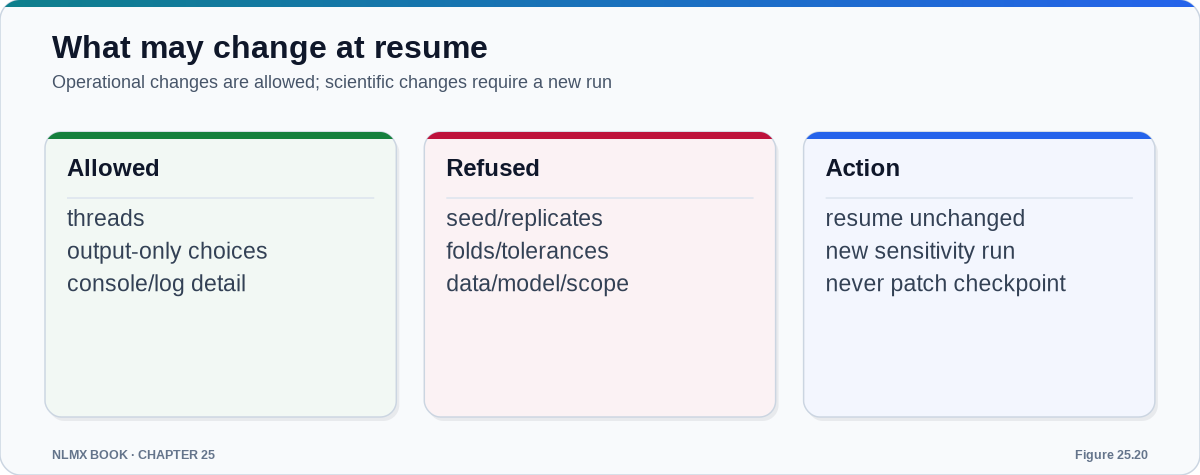
Allowed changes are operational: worker thread count, output-only choices, and console/log presentation. The implementation reconstructs the original command and explicitly permits a new --threads. Results are designed to be independent of thread count because stochastic streams derive from stable unit identities and aggregation follows the stored state.
Refused changes include input bytes, model/data/covariance/PHI, candidate scope/forms/statuses, seed, replicate counts/fraction, draw design, learners/primary/tuning/CV, thresholds and error control, mode tolerances/iterations, approximation, and code/schema/RNG version. These define a different analysis.
If a numerical setting must change to address failure, preserve the interrupted bundle and start a separately labeled sensitivity. Never copy a checkpoint into a new configuration folder to bypass identity. The refusal is a data-integrity feature, not an inconvenience to work around.
Common mistakes
- Changing the scientific question after seeing the result while presenting it as the original run.
- Reading one engine's summary without checking its prerequisites, failures, normalized settings, and fitted endpoint.
- Treating a generated draft, comparison label, or completed checkpoint as a substitute for model diagnostics and reference-software confirmation.
Page checklist
- The exact command, version, inputs, resolved settings, and output directory are identifiable.
- Engine-specific evidence is interpreted on its own scale before cross-method comparison.
- Recovery state, final refit, diagnostics, and remaining confirmation work are explicit.