Chapter 18 — Estimation theory: likelihoods and algorithms
Population pharmacometric estimation asks one deceptively simple question: which population parameters make the observed collection of subject profiles most plausible? The difficulty is that each subject has unobserved random effects, nonlinear model predictions, repeated observations, and residual error. nlmx must integrate over those unobserved effects while respecting parameter bounds and covariance structure.
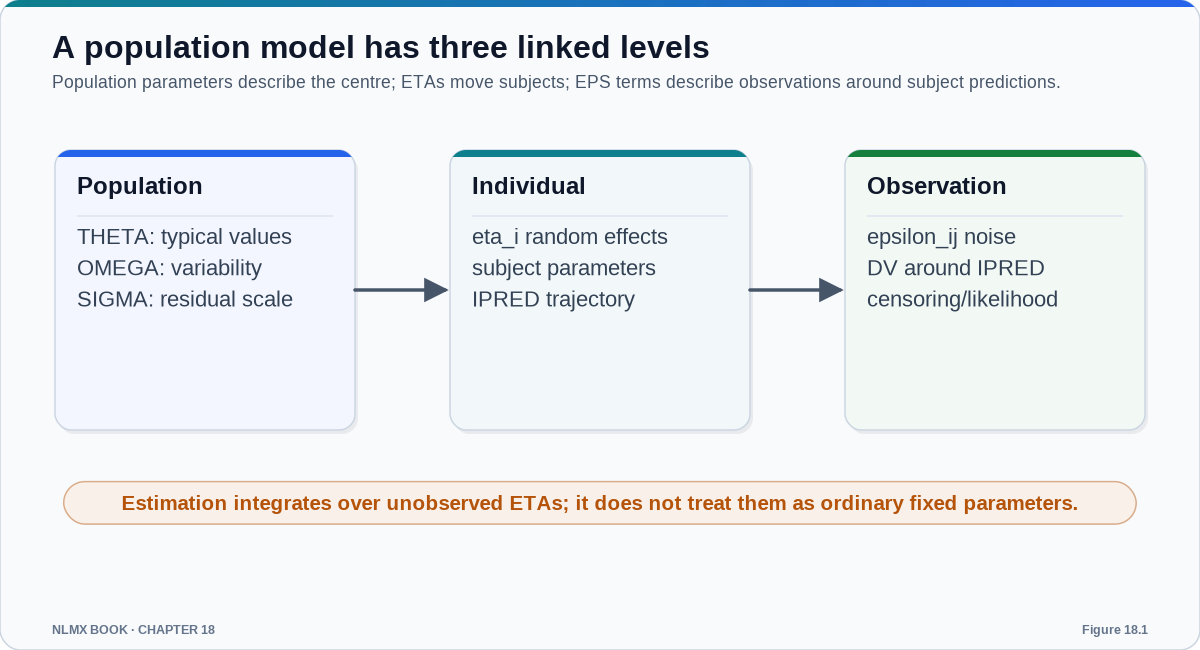
This chapter builds that calculation from first principles. It defines one notation system, derives the conditional and marginal likelihoods, explains FO, FOCE, FOCE-I and Laplace, opens the inner conditional-mode search and outer BFGS optimizer, then develops the covariance step, predictions, residuals and shrinkage. The final pages show how to compare nlmx with NONMEM or another implementation without confusing algorithmic details with scientific disagreement.
The text is verified against nlmx 4.6.0. SAEM and its importance-sampling objective are deliberately deferred to Chapter 19. The fit command interface and complete option index follow in Chapter 20.
Learning outcomes
You should finish able to write the nonlinear mixed-effects likelihood, explain why ETAs are integrated rather than simply fitted, distinguish the four classical approximations, interpret convergence and covariance evidence, calculate common residuals, and design a fair cross-software comparison. You should also recognize when an OFV is not comparable.
Numerical evidence
Two deterministic examples accompany the chapter. A linear random-intercept example has an analytic marginal likelihood on which all four classical methods coincide. A nonlinear example uses numerical integration as a reference and shows method-dependent modes and objective approximations. These are teaching calculations, not validation of general accuracy.
Reading route
New readers should follow the pages in order through 18.15, then read optimization, covariance, and output interpretation. Experienced readers can begin with the notation index, method comparison, or cross-software tolerance.