16.16 Parameter availability by route and structure
Autoinit writes a consistent parameter catalogue, but SOURCE and NOTE distinguish estimates from fixed conventions and structural rules.
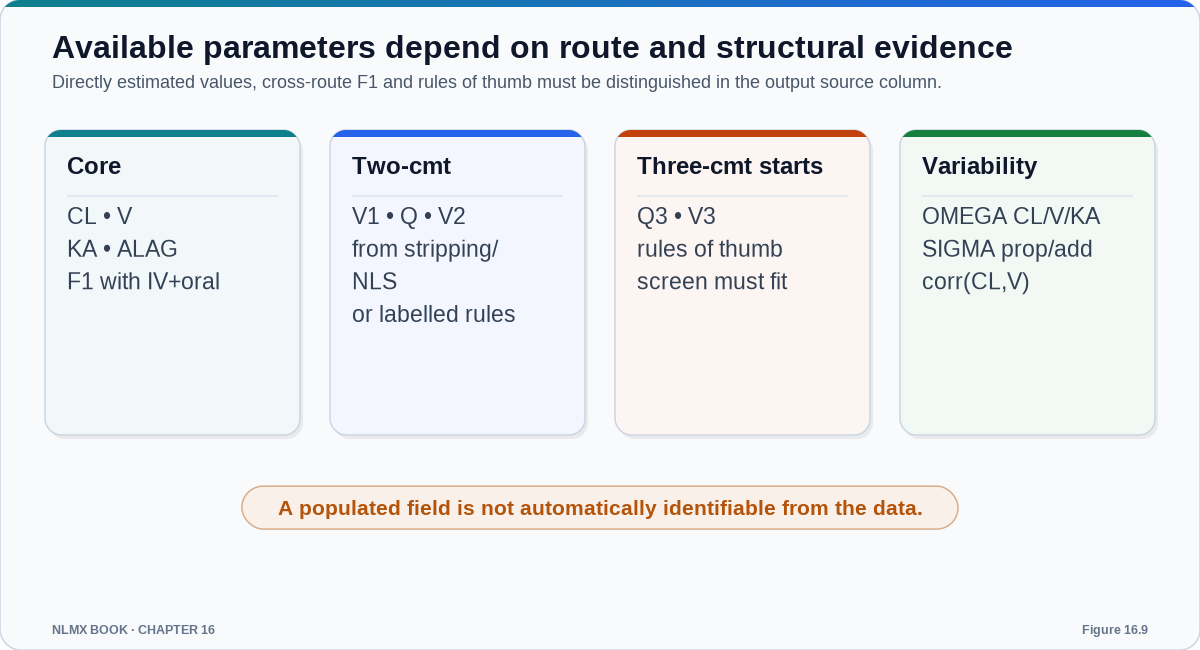
| Parameter | Primary evidence |
|---|---|
| CL, V | NCA/NLS/ML; apparent after oral-only dosing. |
| KA | Oral absorption profiles; conventional flip-flop branch. |
| ALAG | Pre-first-measurable pattern across oral subjects. |
| F1 | Within-subject dose-normalised oral/IV AUC. |
| V1, Q, V2 | Two-compartment NLS or NCA stripping; otherwise labelled rules. |
| Q3, V3 | Rule-of-thumb three-compartment starts. |
| OMEGA CL/V/KA | ML or spread of individual estimates. |
| SIGMA_PROP/ADD | NLS residual and LLOQ/low-concentration rules. |
With oral-only data, CL and V mean CL/F and V/F, while F1 is fixed to 1 because absolute F is unidentified. IV data identify systemic CL/V but do not identify KA. Mixed within-subject routes can provide F1.
Three-compartment Q3/V3 are not discovered from a formal three-compartment fit. They are deliberately plausible starting rules for later screening. Likewise, V1/Q/V2 can be rules when two-compartment evidence is insufficient. A numeric cell is therefore not enough; downstream code should retain SOURCE and NOTE.
Model-specific blocks map these generic values into ADVAN parameter names and compartment numbering. Verify the target model's parameterisation, dose compartment, observation compartment, and S line.
Availability is also conditional on sampling information. An oral dose does not guarantee useful KA when early samples are absent, and an IV dose does not guarantee distribution parameters when the initial phase is missed. Treat the table as a map of possible evidence, then use N, SOURCE, method blanks, and plots to decide what the particular dataset actually supplied.
Common mistakes
- Treating every populated value as directly identified.
- Calling oral CL/F systemic clearance.
- Expecting KA from IV-only data.
- Reporting Q3/V3 rules as estimated distribution parameters.
Checklist
- Classify route evidence.
- Read SOURCE/NOTE for every parameter.
- Separate direct, combined, fixed, and rule values.
- Match target parameterisation and compartments.
- Let screening/fitting test structural proposals.
Further reading
See F1 and mixed routes, multi-compartment rules, and initial-estimates output.