24.6 Reconstructing modes and curvature
Reconstruction uses each subject's records, base parameters, OMEGA, and residual likelihood. nlmx optimizes the conditional ETA mode, then evaluates local curvature to approximate posterior covariance. Mode tolerance and maximum iterations are shared numerical controls.
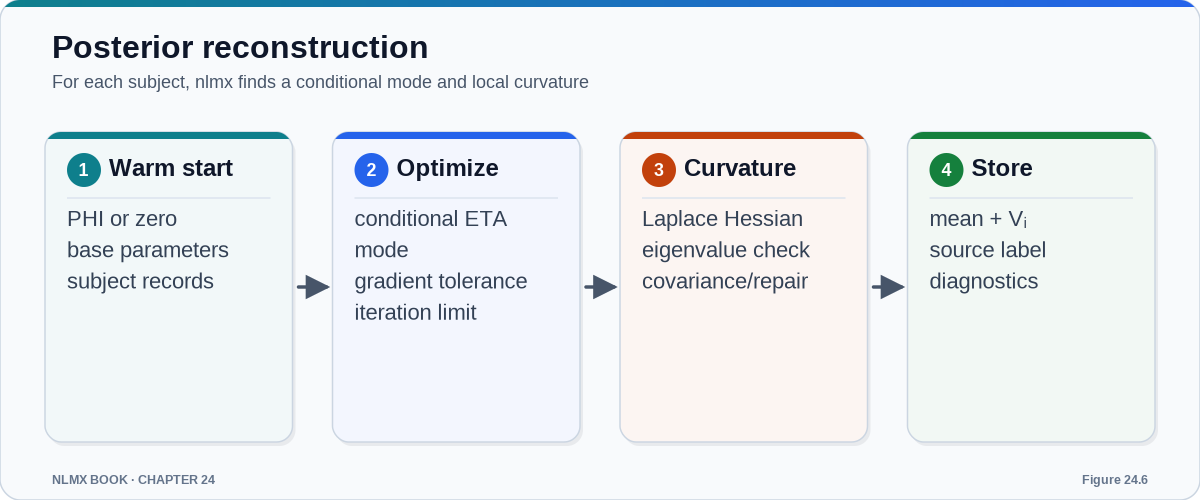
Warm starts from available PHI values can improve convergence, but the reconstructed result belongs to nlmx's likelihood. Failed modes, singular curvature, or excessive repairs are handled by the configured subject policy. Review failures by design and covariate; excluding predominantly sparse or extreme subjects can bias stability results.
Reconstruction is useful when PHI/ETC is absent or when internal consistency matters. It can be computationally significant for ODE models or many subjects, though it is performed once before the stability loop rather than once per learner fit under ordinary settings.
Validate reconstruction against trusted PHI/ETC on representative models before treating sources as interchangeable.
Common mistakes
- Assuming a converged mode guarantees usable covariance.
- Ignoring which subjects required reconstruction.
- Excluding failed subjects without bias assessment.
- Comparing reconstructed and PHI results without matching likelihood conventions.
- Tightening tolerances without evaluating computational/numerical effects.
Checklist
- Review mode iterations, gradients, and failures.
- Inspect curvature eigenvalues and repair sizes.
- Compare source variants on qualified datasets.
- Assess source patterns by study and covariates.
- Record numerical settings and runtime.
Further reading
See posterior approximations and failure policies.