16.19 Multi-compartment rules and transit blocks
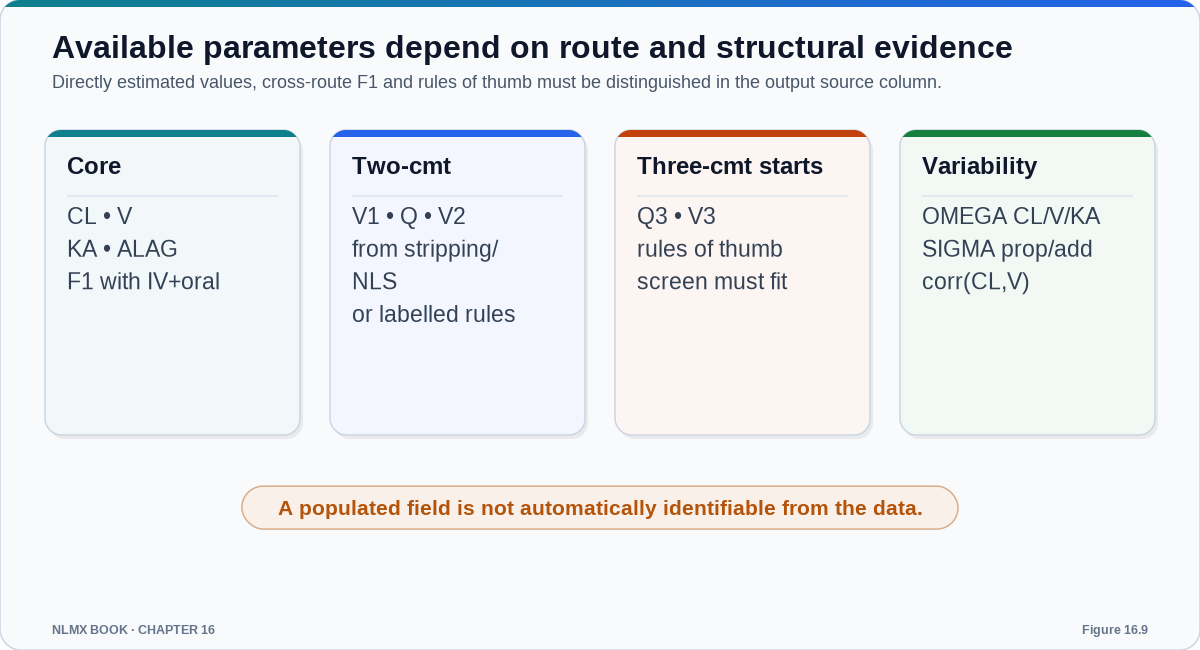
Autoinit prepares values for one-, two-, and three-compartment model starts even when the data do not directly identify every structure. SOURCE and NOTE distinguish evidence from fallback rules.
Two compartments
When NLS support meets the dataset-level criterion, V1, Q, and V2 come from two-compartment individual fits. NCA curve stripping provides a comparison. Without support, defaults use approximately V1=0.4V, V2=0.6V, and Q=CL. These values are designed to start a screen, not assert a distribution mechanism.
Three compartments
Q3 and V3 are rules derived from two-compartment values. Autoinit does not perform a formal three-compartment individual fit. In true three-compartment systems, central volume may be only roughly initialized. Chapter 17 screening and population fitting must decide whether the added structure is supported.
Transit absorption blocks
For oral data, --absorption transit appends one- and two-compartment $DES proposals with a Savic-style transit input. MTT starts at twice ALAG when lag exists, otherwise approximately 1/KA; NN starts at 3. The ordinary first-order blocks remain. Parameter estimates are unchanged by the option.
Generated transit code records dose/time state and computes gamma-distributed input. It needs review for multiple doses, resets, dataset compartments, and target software compatibility. Paste-ready means syntactically structured—not automatically study-ready.
Common mistakes
- Reporting fallback V1/Q/V2 as fitted estimates.
- Claiming Q3/V3 reveal a third compartment.
- Expecting
--absorption transitto refit absorption. - Pasting
$DEScode without reconciling CMT and events.
Checklist
- Read SOURCE for every structural parameter.
- Separate two-cmt evidence from rules.
- Treat three-cmt values as starting heuristics.
- Review transit event/code assumptions.
- Use structural screening and diagnostics afterward.
Further reading
Review two-compartment check, generated blocks, scaled/transit example, and Chapter 17 in the remaining plan.