21.17 ETA and EPS shrinkage
nlmx reports standard-deviation-based shrinkage using the documented formulas:
ETA shrinkage(k) = 1 - SD(ETA-hat_k) / sqrt(OMEGA_kk)
EPS shrinkage    = 1 - SD(IWRES)
ETA shrinkage measures compression of EBEs toward zero relative to the population random-effect SD. It tends to increase when subjects have sparse or uninformative observations, residual variability is large, parameters are weakly sensitive, or the model cannot distinguish effects. High shrinkage means subject ranking, ETA histograms, ETA–covariate plots, and ETA correlations may be unreliable.
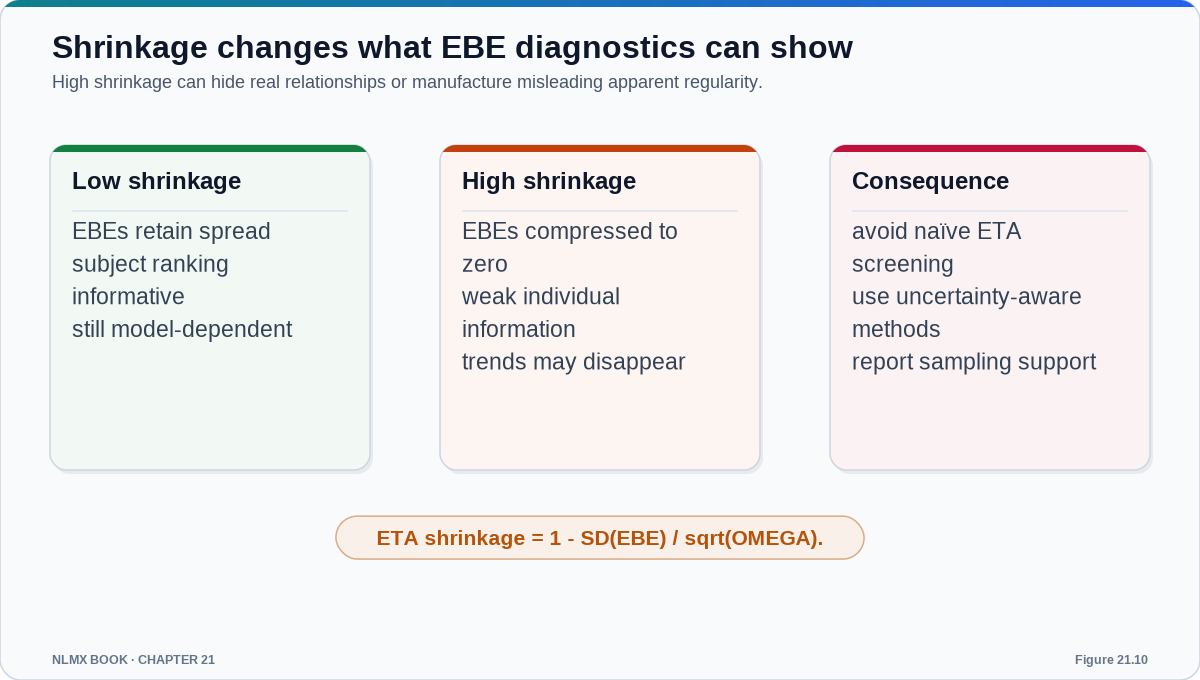
Shrinkage is parameter-specific and design-specific. A rich absorption phase can support KA while a sparse terminal phase leaves CL or V weakly informed. Report each ETA rather than one overall number. There is no universal accept/reject threshold; values such as 20–30% are often used as attention points, not laws. Interpret the analysis purpose and sampling design.
EPS shrinkage summarizes the spread of IWRES. It does not prove residual normality or independence. Review IWRES distributions and plots alongside it. Negative shrinkage can occur when empirical spread exceeds the model reference; investigate rather than truncating it to zero.
In the Chapter 20 example, both ETA shrinkages are about 2.3%, consistent with eight postdose observations per subject and informative synthetic profiles. EPS shrinkage is about 12.1%. These favorable values do not resolve the additive-error parameter’s boundary warning.
Common mistakes
- Treating shrinkage as a software quality score.
- Applying one universal cutoff to every purpose.
- Using high-shrinkage EBEs for naïve covariate screening.
- Reporting only an average across ETAs.
- Assuming low shrinkage proves model adequacy.
Checklist
- Report shrinkage by ETA and EPS separately.
- Relate it to sampling, sensitivity, and residual error.
- Limit EBE-based interpretations when shrinkage is high.
- Investigate negative or unexpectedly different values.
- Pair shrinkage with OMEGA, uncertainty, and diagnostics.
Further reading
Review ETA distributions, identifiability, and Chapter 24’s future posterior-stability treatment.