36.30 Shared model-artifact selection options
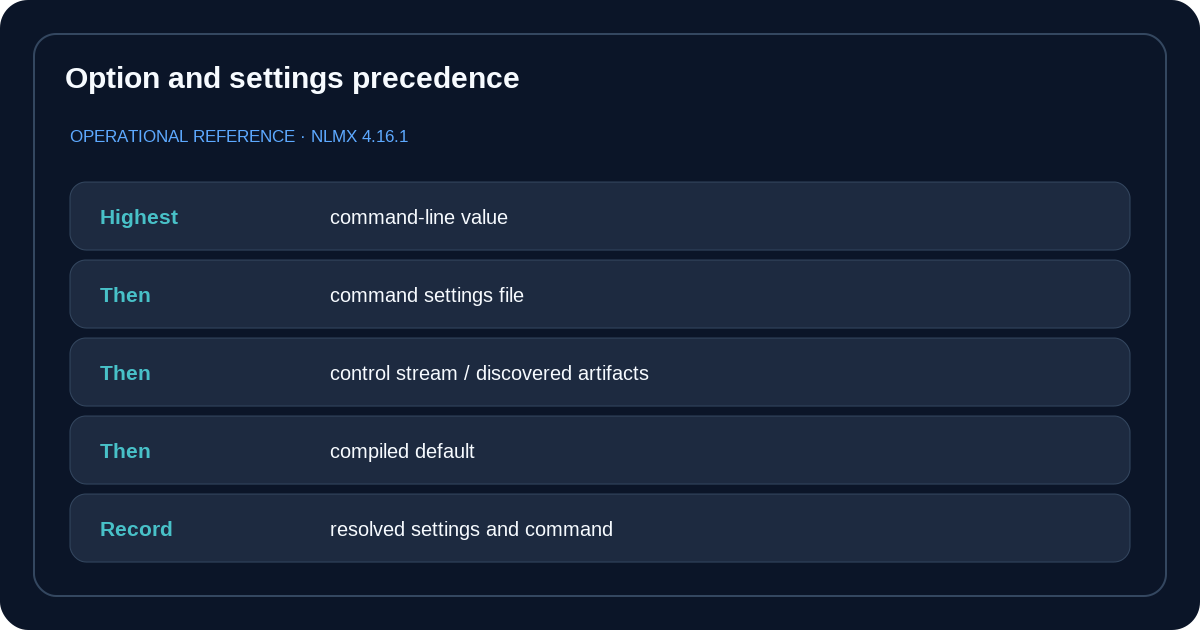
This chapter is a lookup reference for nlmx 4.16.1. Option tables are generated from the installed release executable. Read an option in the context of the command page: nlmx uses a global parser, but an accepted option can be irrelevant to a command unless its help text names that command or the command's method chapter defines the behavior.
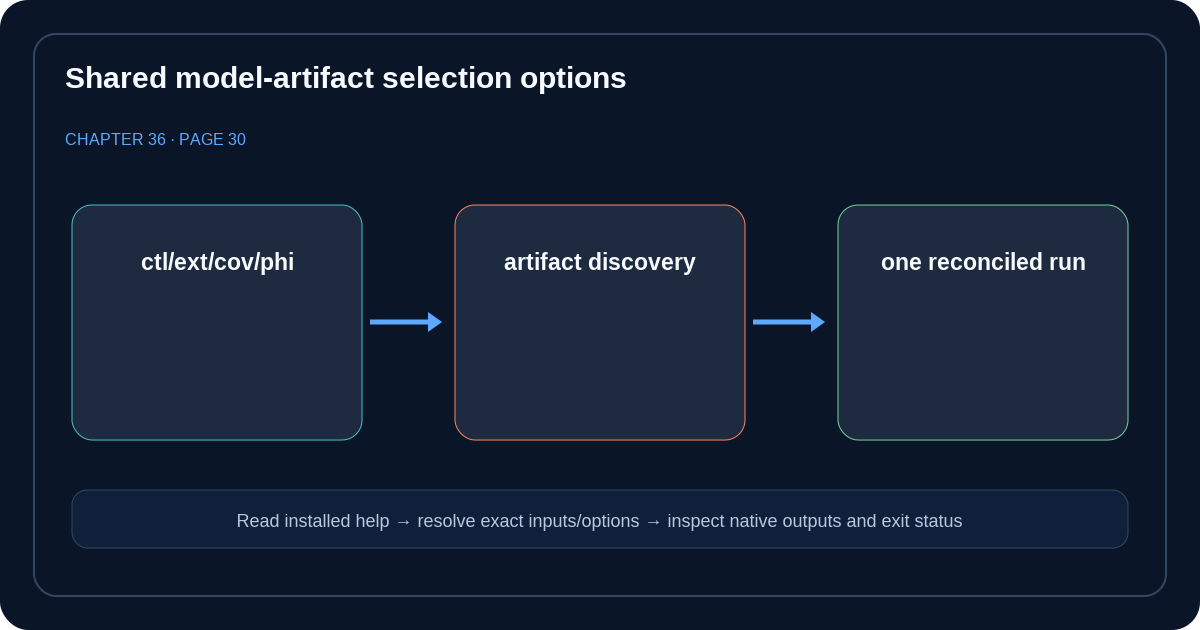
The safe sequence is: identify the installed version, open that command's help, freeze input/settings/output paths, run into a new or empty output directory, inspect both the process status and the command-native verdict, and retain the log/resolved settings/checksums. A command line is reproducible only when its referenced files and software version are also frozen.
Artifact discovery is convenient but must be auditable
--model-dir asks nlmx to identify one run family in a directory. --run-stem disambiguates multiple stems. --recursive widens discovery. Explicit --ctl, --ext, --cov, --cor, --lst, --phi, and --table replace or supplement discovery depending on the command. --files supplies an explicit manifest whose relative paths resolve against the manifest.
The files must belong to the same model/run. Matching dimensions are necessary but not sufficient; verify stem, timestamps/provenance, parameter ordering, subject population, approximation, and dataset identity. .ext supplies estimates/objective history, .cov parameter covariance, .cor correlation, .coi inverse covariance/information where supported, .phi subject estimates/posterior information, and table files can provide ETA values.
For automation, prefer an explicit manifest or isolated run directory. Recursive discovery in a directory containing archival and current results increases ambiguity. Never solve an artifact mismatch by renaming unrelated files to a common stem.
Novice review checklist
- Can you identify the exact installed nlmx version and canonical command?
- Are positional inputs, named options, settings, and output paths unambiguous?
- Did you distinguish parser acceptance from command-specific meaning?
- Will the run preserve enough native evidence to determine semantic success?
- Is a qualified human decision required after the software completes?
Navigation
See the previous page, next page, and complete command index.