13.28 Limits, good practice, and validation
EDA reveals distributions, associations, anomalies, and design patterns. It does not establish causal effects, structural-model correctness, likelihood choice, identifiability, or agreement with other pharmacometric software.
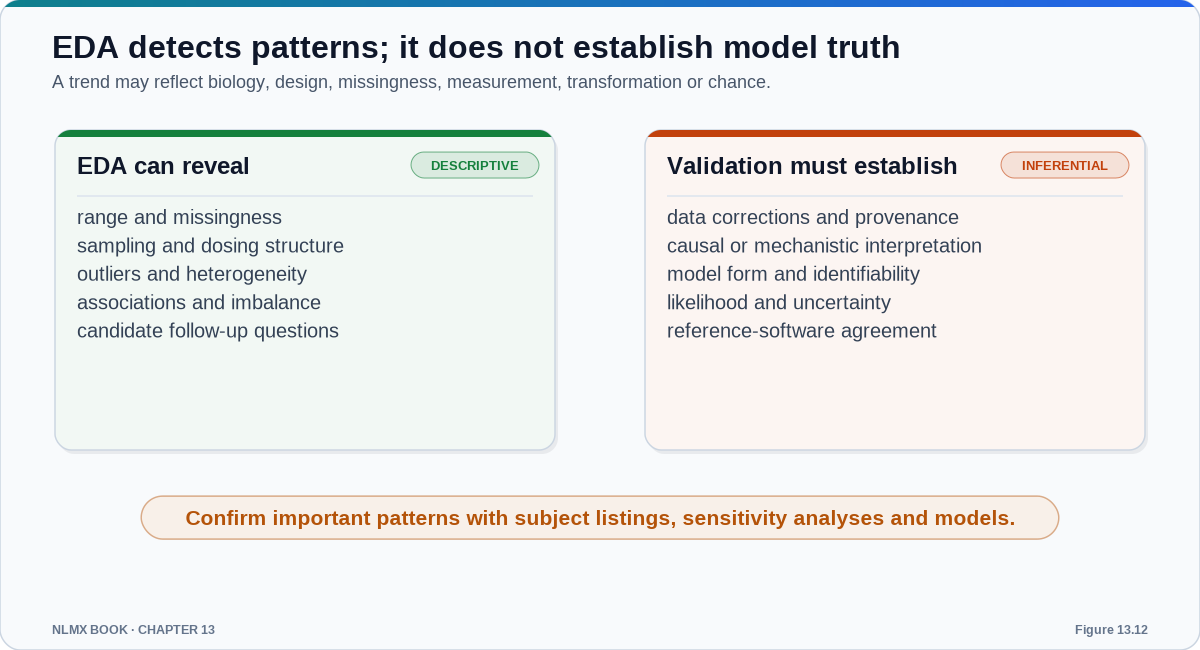
Competing explanations
An outlier may be an error, a valid extreme subject, an unrecorded covariate, or model-relevant heterogeneity. A group difference may reflect dose, study, sampling, missingness, assay, or population imbalance. A correlation may be direct, derived, confounded, nonlinear, or driven by one point. Document alternatives before correcting data or specifying a model.
EDA calculations also have implementation boundaries. Automatic classification, time/dose derivation, observed exposure, interpolation for PK-PD, LOESS, binning, and page caps require frozen fixtures. New versions can change defaults or catalogues; compare by stable IDs and machine-readable results.
Validation program
Create fixtures for each P01–P24 and T01–T10, including applicability/skipping. Test mutations, filters, missing/infinite values, DVID/BLQ/TAD mappings, multiple dosing, time-varying covariates, exposure intervals, all custom kinds/scopes, pagination, and formats. Compare numeric tables to independent reference calculations with predefined tolerances and inspect figures structurally (series, axes, groups, counts), not pixel-for-pixel alone.
Benchmark speed separately from accuracy. Faster generation is valuable only when the same analysis population, statistics, and meanings are preserved.
Validation should also include visual invariants: expected axis variables/units, group and facet levels, series counts, log exclusions, pagination, and captions. Pixel identity is too strict across rendering libraries, while merely opening the file is too weak. Combine structural checks with independent numeric table comparisons and human review.
Common mistakes
- Deleting outliers because a plot looks unusual.
- Turning exploratory patterns into confirmatory claims.
- Testing only attractive, complete datasets.
- Changing tolerances or definitions after seeing disagreements.
Checklist
- State EDA questions and nonclaims.
- Preserve all transformations and exclusions.
- Validate every catalogue item and custom kind with fixtures.
- Predefine numeric/structural acceptance criteria.
- Carry confirmed issues into QC, modelling, and sensitivity plans.
Further reading
See Chapter 9 reproducibility, Chapter 11 dataset QC, and remaining validation work.