15.16 Absolute bioavailability output
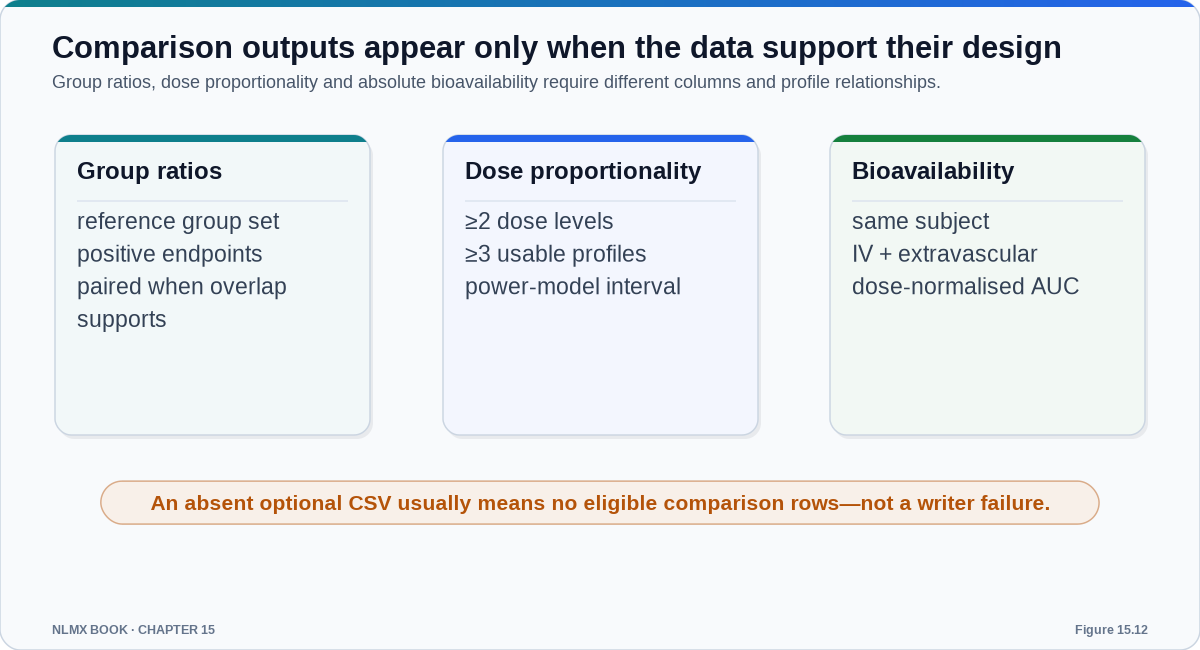
With [comparison] bioavailability = true—the default—nlmx searches for subjects with a single-dose intravenous profile and a single-dose extravascular profile. For eligible subjects it writes nca_bioavailability.csv with dose-normalised ratios from AUClast and AUCinf.
F = (AUC_extravascular / Dose_extravascular)
    / (AUC_intravenous / Dose_intravenous)
Required structure
The same subject must contribute both routes. Automatic route classification must therefore be correct, and profile selection must retain the relevant occasions. Dose amounts and AUC units must be coherent. The IV and extravascular profiles should use comparable analyte, sampling duration, BLQ rule, and AUC definition.
Output columns include subject, group, IV route, IV dose, extravascular dose, F_AUCLAST, and F_AUCINF. AUClast bioavailability is directly limited to sampled exposure and can be biased if route profiles have different coverage. AUCinf is more comparable in concept but inherits both terminal fits and extrapolated tails.
The file is conditional: absence means no eligible paired route profiles or no calculable result, not necessarily an output failure. Check route, interval selection, skips, and AUC availability first.
Interpretation and review
The worked crossover was generated with oral systemic availability 0.72. Its finite sample/trapezoid results are about 0.712 from AUClast and 0.713 from AUCinf. The difference from 0.72 reflects numerical sampling and route-specific extrapolation rather than automatic calibration.
Values above one can occur from variability, sampling, or bias and should not be clipped. Summarize subjects using a prespecified method and investigate period, sequence, or carryover effects outside this simple ratio output.
Common mistakes
- Expecting bioavailability from separate IV and oral subject groups.
- Using AUClast when route sampling windows differ materially.
- Ignoring route-specific flags in the two source profiles.
- Truncating F at 1.
Checklist
- Confirm within-subject IV and extravascular pairing.
- Match dose, analyte, units, and sampling support.
- Inspect both source profiles and terminal diagnostics.
- Compare AUClast- and AUCinf-based F.
- Address crossover design effects separately.
Further reading
See bioavailability theory, mixed-route controls, and the worked crossover.