nlmx
A practical guide to fast, reproducible pharmacometrics
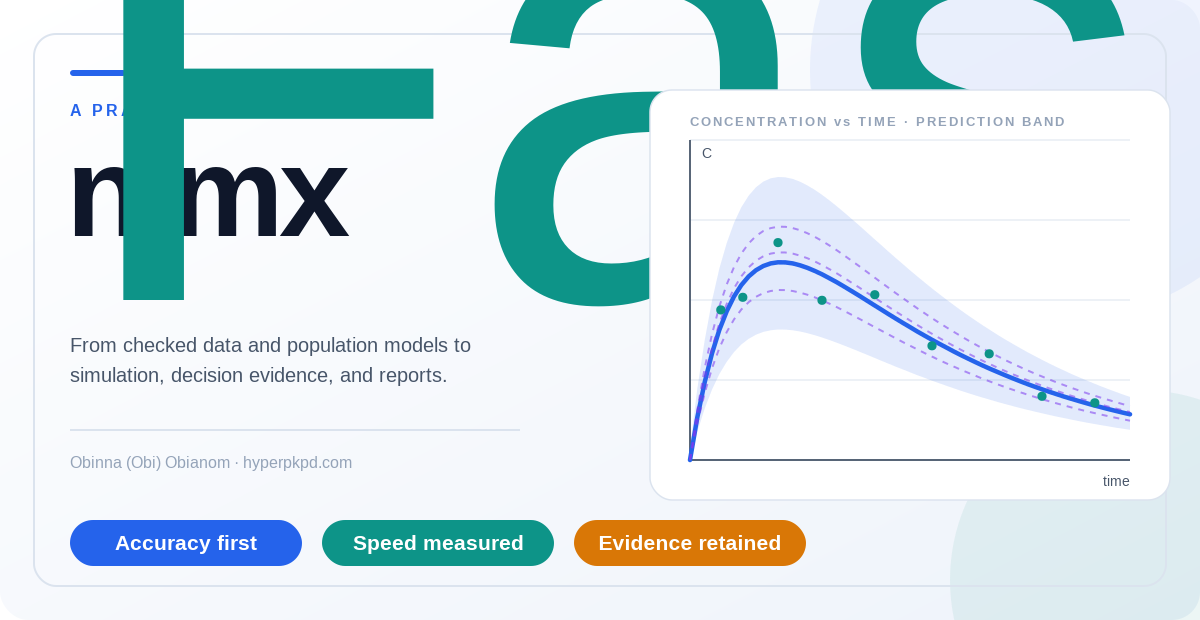
Author and copyright holder: Obinna (Obi) Obianom
Website: hyperpkpd.com
Licence: Creative Commons Attribution-NoDerivatives 4.0 International (CC-BY-ND-4.0)
This book explains how to use nlmx from the first inspection of a pharmacometric dataset through model building, covariate analysis, model evaluation, study simulation, trial-design calculations, exposure-response analysis, and reporting. It also explains the mathematical and operational assumptions behind those steps. The goal is not merely to show commands that run. The goal is to help a reader decide whether the resulting evidence is scientifically appropriate, numerically reliable, reproducible, and reviewable.
The governing priority
nlmx is designed to reproduce important capabilities of major pharmacometrics software while making many workflows faster. Speed is valuable only after the scientific question, data interpretation, model semantics, objective, and acceptance criteria have been aligned. Throughout this book, accuracy and decision equivalence are gates; speed is measured after those gates pass.
How to cite this software
Use the exact version that produced the reported results:
Obianom O. nlmx: complete PK/PD pharmacometrics software, version X.Y.Z (year). https://hyperpkpd.com
Replace X.Y.Z with the output of nlmx --version. Record the operating system, effective settings, input hashes, and analysis output with the citation when those details could affect reproduction.
What this edition covers
Commands, options, schemas, defaults, file layouts, and numerical behavior can change across releases; a statement in this book should not be silently applied to a different executable. Check the page's version scope, and confirm the behavior with the executable you actually run.
The current book contains this front matter and Chapters 1–40. Chapter 41 (worked case studies), Chapter 42 (validation and testing), and the appendices remain on the writing plan. Links to planned material are therefore signposts, not claims that the page already exists. The remaining-chapters page is the authoritative writing-status summary.
A promise to the reader
Every operational chapter aims to answer five questions:
- What question does the method answer? A command name is not a scientific objective.
- What exactly goes in? Data columns, control streams, settings, versions, and assumptions are inputs.
- What does nlmx compute? Equations, approximations, algorithms, and stopping rules matter.
- What comes out? Results, warnings, figures, logs, manifests, and failure states are all evidence.
- What should a reviewer verify? A successful exit is necessary but never sufficient for a defensible conclusion.
The examples use explicit commands and plain-text artifacts so that a novice can follow them and an experienced reviewer can audit them. A worked result is an illustration, not a universal acceptance limit. Where a result requires qualification against another implementation, the book says so.
Before using an analysis result
- Confirm the executable with
nlmx --versionand inspectnlmx --license. - Freeze the model, dataset, settings, and relevant external reference outputs.
- Read warnings and the resolved-settings record, not just the headline table.
- Distinguish a numerical discrepancy from a scientific discrepancy.
- Preserve the complete output folder before preparing a reduced report package.
- Apply your organisation's intended-use validation, change control, and independent review.
Regulatory and validation boundary
This book and the software's tests can support a validation effort; they do not make every installation, workflow, model, or decision validated for every intended use. The user remains responsible for qualification of the installed build, controlled procedures, traceability, acceptance criteria, and review.
Navigation
Continue to edition, copyright, licence, and citation. Readers who are new to pharmacometrics should then read the preface, audience and prerequisites, and reading paths before Chapter 1.