Chapter 24 — The posterior-stability engine
The posterior-stability engine asks whether a parameter–covariate relationship is selected repeatedly when three sources of fragility are exposed: uncertainty in each subject's random effects, variation in the sampled subjects, and differences among statistical learners. It targets reproducibility of a covariate signal rather than one local score or one stepwise likelihood path.
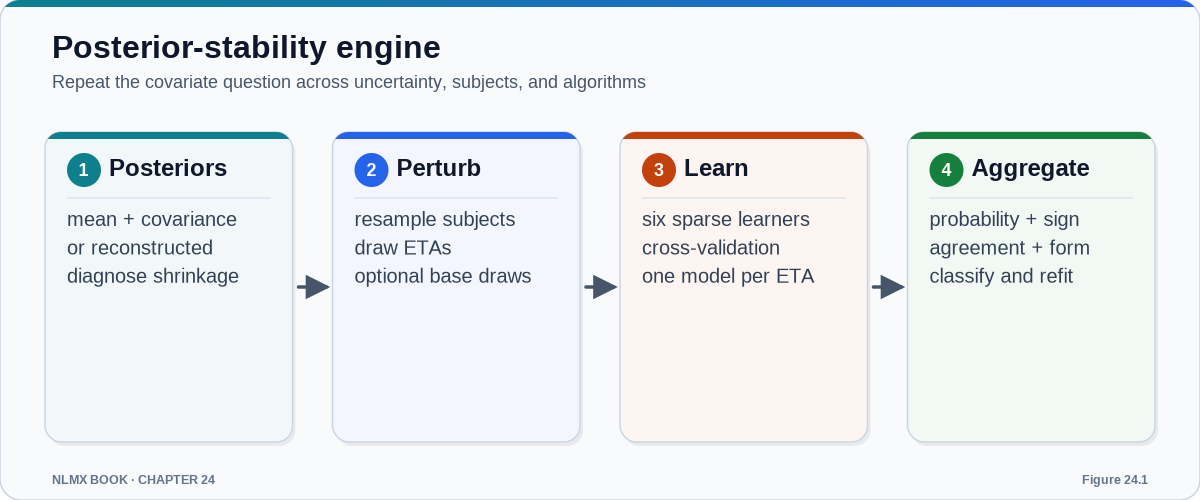
This chapter follows the complete implementation in nlmx 4.8.0. It explains posterior sources and reconstruction, PHI/ETC covariance, Laplace curvature and repair gates, shrinkage and the posterior moment identity, feature generation and proxy clusters, posterior draw methods, four resampling schemes, base-parameter perturbations, six learners, cross-validation, stability metrics, error control, classification, checkpoint/resume, failures, outputs, final refitting, and qualification.
The worked study uses the same deterministic 60-subject, 480-observation model as Chapters 22–23. Four reproducible variants are archived under documents/ch24: posterior draws with the three default learners and a final refit; posterior means; bootstrap resampling; and all six learners. The primary run retained CL–WT and V–WT, placed CL–EGFR in the uncertainty band, and rejected both simulated-null SEX relationships. The variation across analysis designs is used to teach what a stability probability does—and does not—mean.
Novice readers should follow pages 24.1–24.20 before interpreting probabilities. Statistical readers can start at the posterior reconstruction, resampling, or learner sections. Operational users can begin with the complete command/settings index, worked run, or validation checklist.
Selection probability is not the posterior probability that an effect exists. It is the empirical frequency with which the configured primary learner selects a feature under a specified perturbation schedule.