27.5 Design replay: dosing, covariates, and occasions
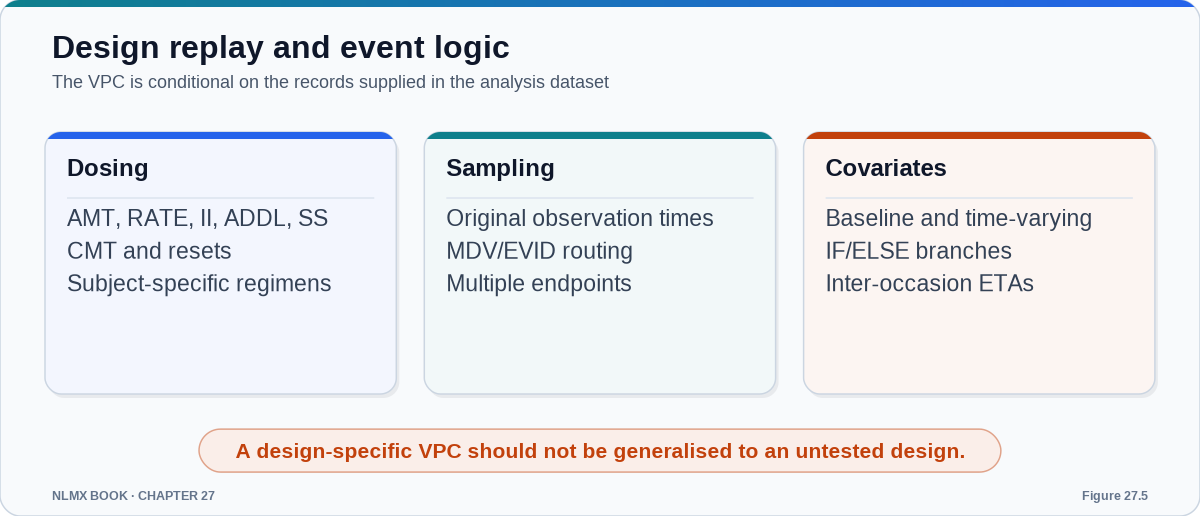
The analysis dataset is read with NONMEM-style $INPUT, $DATA IGNORE/ACCEPT, and event fields. AMT, RATE, II, ADDL, SS, CMT, EVID, and MDV reconstruct dosing and observation events. Covariates and IF/ELSE logic are evaluated at their record values, including time-varying and inter-occasion behavior.
Novice translation
This topic changes three practical decisions in a predictive-check review. First, every simulated replicate has the same number and arrangement of eligible observations unless filtering changes the included subjects. Second, subject-specific regimens remain subject-specific; the VPC therefore evaluates the fitted model under the observed mixture of designs. Third, multiple endpoints should be stratified by DVID, CMT, or another endpoint identifier so incompatible scales are not pooled. Keep those decisions separate: one defines what is simulated or summarised, another controls how evidence is displayed, and the last controls what conclusion the evidence can support. A reviewer should be able to reproduce each decision from the resolved settings and numerical tables, not infer it from the appearance of the figure.
What to understand
- Every simulated replicate has the same number and arrangement of eligible observations unless filtering changes the included subjects.
- Subject-specific regimens remain subject-specific; the VPC therefore evaluates the fitted model under the observed mixture of designs.
- Multiple endpoints should be stratified by DVID, CMT, or another endpoint identifier so incompatible scales are not pooled.
Practical interpretation
Inspect vpc_observations.csv to verify row identity, PRED, IDV, stratum, bin, and correction before interpreting the bands.
Evidence to retain
For design replay: dosing, covariates, and occasions, retain the issued command, vpc_settings.vpc, the source model/data/result identifiers, seed and replicate count, the relevant CSV/JSON fields, warnings and notes, and the exact figure used for interpretation. Record any sensitivity run that changed the conclusion. If an option was selected after seeing the data, label that analysis exploratory. This evidence separates a reproducible diagnostic decision from a visual impression and lets another pharmacometrician check counts, transformations, exclusions, and uncertainty assumptions.
Common mistakes
- Pooling endpoints
- Forgetting ADDL/II doses
- Generalising beyond the observed design
Page checklist
- Validate event fields
- Check time-varying covariates
- Stratify endpoints
- Confirm observation count
Further reading
See previous page, next page, complete VPC command and settings index.