Chapter 22 — Covariate modelling concepts and operational map
Covariate modelling explains systematic differences in pharmacokinetic or pharmacodynamic parameters using subject, treatment, disease, or study characteristics. A defensible analysis must do more than select statistically significant terms: it must define the estimand, choose meaningful equations and references, handle missing and time-varying values, control a scientifically plausible scope, quantify uncertainty and selection stability, refit the final model, diagnose it, and translate effects into clinical consequences.
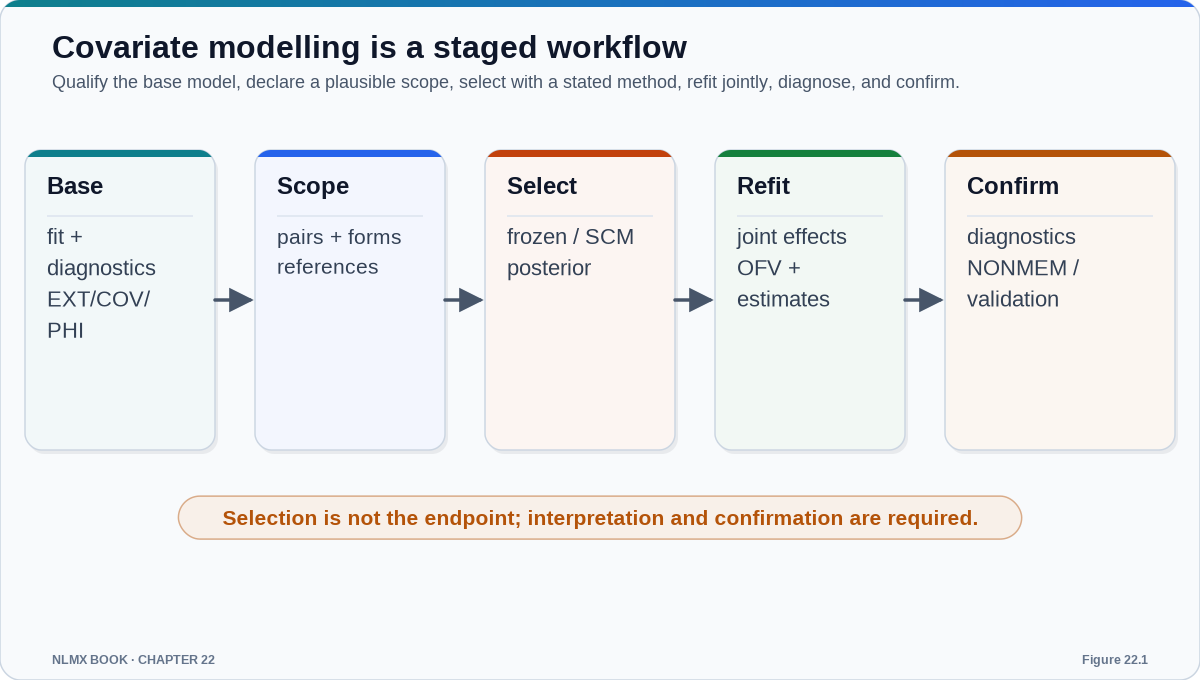
This chapter is the user-level foundation for all nlmx cov methods in version 4.8.0:
- frozen efficient-score screening with conditional forward/backward selection;
- SCM refit-based stepwise covariate modelling using
--method scm; - posterior stability selection across posterior draws, resamples, and learners;
- both, which runs frozen and posterior evidence together.
It also covers the joint final refit, command/configuration surface, complete covariate equation catalogue, scope declarations, form comparison, multiplicity, uncertainty propagation, outputs, draft control stream, diagnostic requirements, and NONMEM confirmation boundary. Chapters 23, 23A, and 24 later derive the frozen, SCM, and posterior algorithms in depth.
The worked evidence under documents/ch22 was generated by nlmx 4.8.0 from a deterministic 60-subject oral dataset with known WT and EGFR effects. Its base fit, frozen run, and SCM run are preserved with logs, reports, tables, draft models, and checksums.
How to read this chapter
Novice users should read pages 22.1–22.20 before running selection. Experienced pharmacometricians can begin with the complete method and option index, method comparison, worked example, or final checklist.
The chapter contains 36 numbered pages plus this overview and the command/method index. Every retained relationship remains an unconfirmed analysis proposal until the generated model is fitted, diagnosed, and qualified in the target workflow.