Likelihood refits and nested models
The likelihood-ratio test requires nesting: the reduced model must be obtainable from the full model by fixing the tested relationship's coefficient block to its null value. The models must use the same observations, likelihood approximation, integration settings, residual model, parameter transformations, and admissibility rules. A different equation form is generally a non-nested comparison and should be handled by the form-comparison rule rather than the SCM LRT.
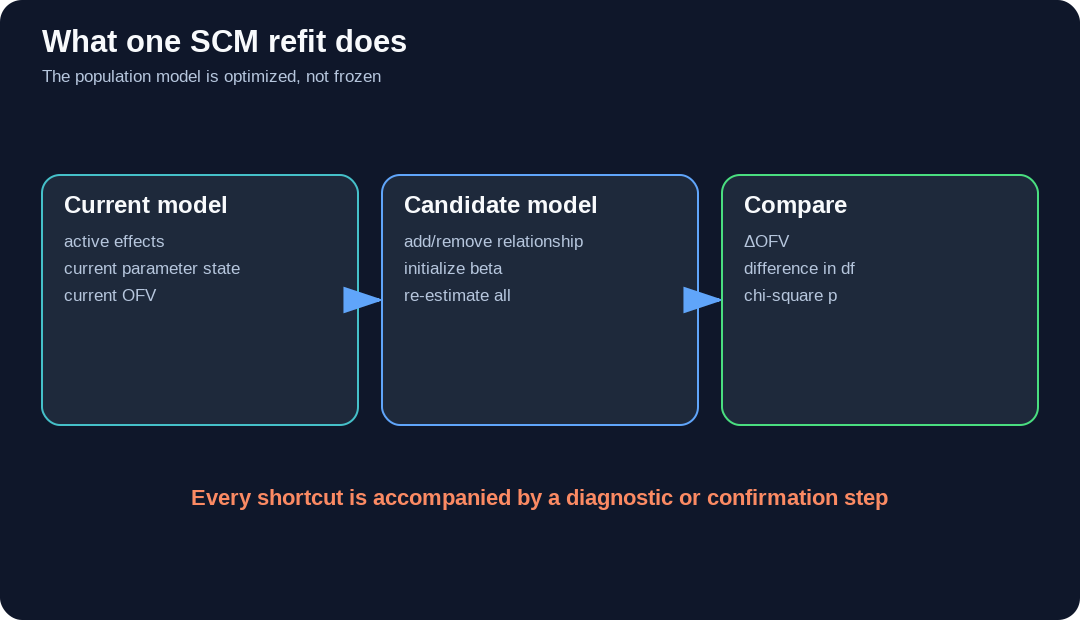
At a forward step, the current model is reduced and the candidate model is full. At a backward step, the current model is full and the one-term-deleted model is reduced. nlmx caches each fitted relationship set so a model encountered again can be reused. The scientific interpretation nevertheless remains conditional on the current set.
Check that the objective is on the same −2 log likelihood scale and that both optimizations reached credible minima. A lower OFV caused by a changed dataset, a boundary workaround, or an unconverged iterate is not valid evidence. Preserve failed comparisons rather than silently assigning them a favorable or unfavorable p-value.
Common mistakes
- Treating a stepwise p-value as clinical importance or causal proof.
- Reading a candidate comparison without its active model, convergence state, degrees of freedom, and exact threshold.
- Reporting only the terminal relationship list while discarding failed models, path decisions, configuration, and provenance.
Page checklist
- The scientific question, model identities, and comparison direction are explicit.
- Numerical validity is reviewed before interpreting statistical evidence.
- The result is linked to the complete trace and final joint-model diagnostics.