Forward and retention thresholds
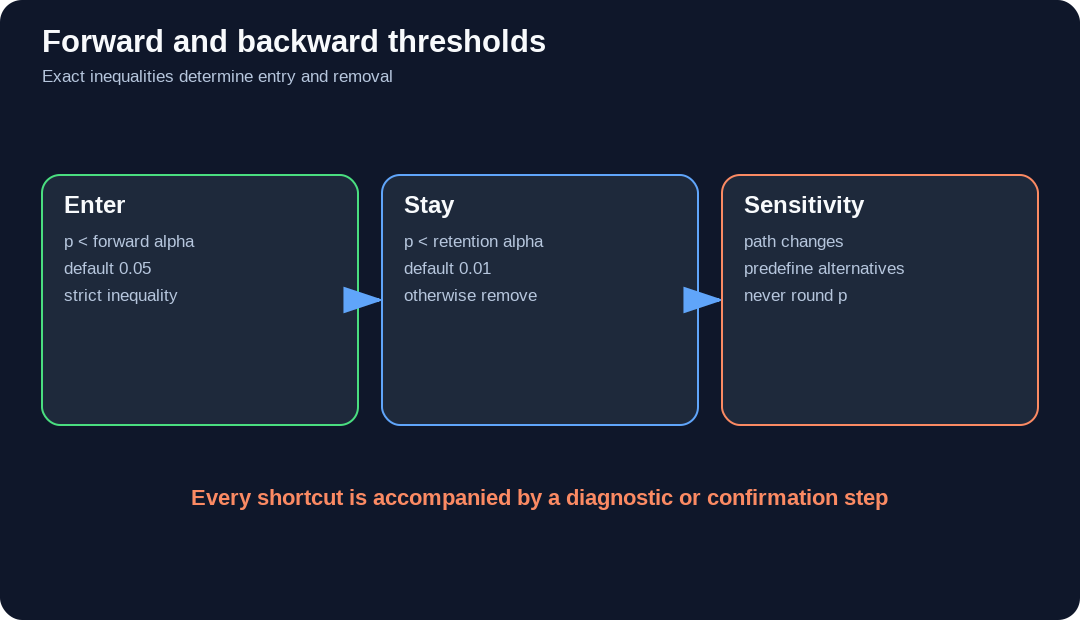
--alpha and --p-forward name the forward entry threshold; --retention-alpha and --p-backward name the backward retention threshold. Defaults are 0.05 and 0.01. A candidate enters only when p < forward; an active term is removed when p >= retention. Exact inequalities matter at the boundary.
The thresholds encode different error-control intentions. A permissive entry rule explores plausible effects, while a stricter retention rule requires stronger conditional evidence in the final joint model. They do not automatically control the overall false-positive probability across many candidates, forms, steps, and directions. Predefine them in an analysis plan and report sensitivity runs without presenting the most favorable one as primary.
In the worked strict run, entry was 0.01 and retention 0.001. The same three true effects remained because their conditional p-values were much smaller than either rule. Stability here is evidence about this synthetic dataset, not a universal endorsement of those thresholds.
Common mistakes
- Treating a stepwise p-value as clinical importance or causal proof.
- Reading a candidate comparison without its active model, convergence state, degrees of freedom, and exact threshold.
- Reporting only the terminal relationship list while discarding failed models, path decisions, configuration, and provenance.
Page checklist
- The scientific question, model identities, and comparison direction are explicit.
- Numerical validity is reviewed before interpreting statistical evidence.
- The result is linked to the complete trace and final joint-model diagnostics.