16.26 Troubleshooting method disagreement and poor starts
Method disagreement is a diagnostic. Work upstream before manually replacing a value.
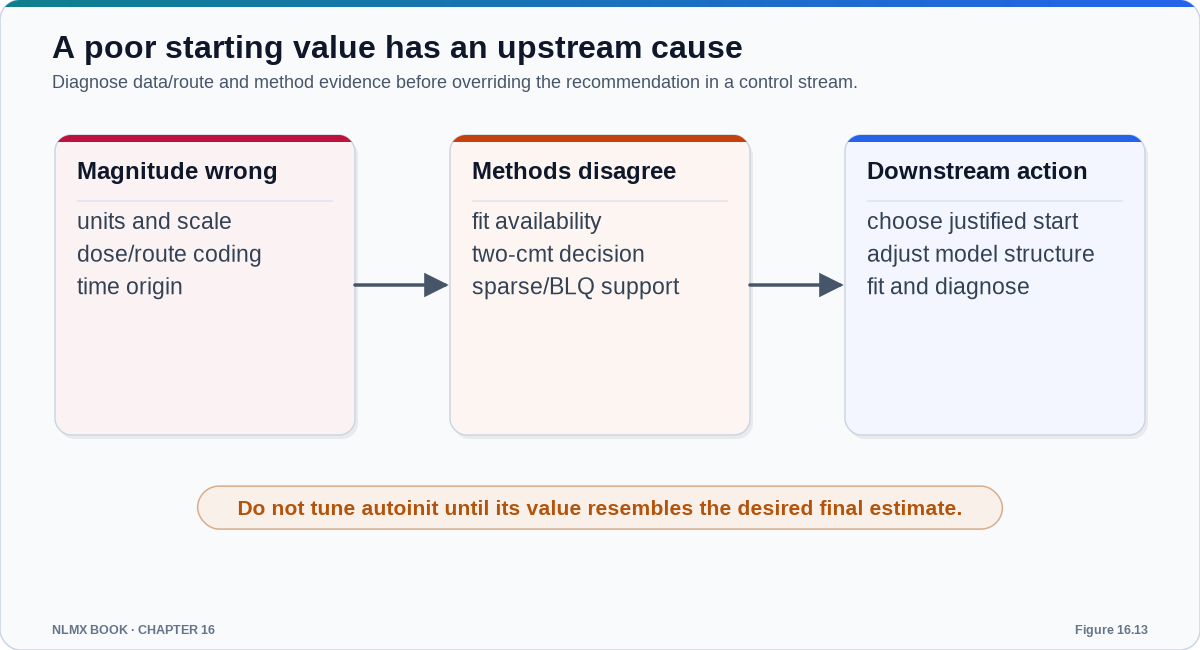
Wrong order of magnitude
First check dose/concentration/time units and scale. Then verify dose records, route, infusion duration, and filters. A 1000-fold CL/V discrepancy is usually scaling, not biology. A low F1 or apparent CL shift may be route pairing or sampling coverage.
NCA differs from NLS/ML
Inspect nca_results.csv: window, terminal points, R², extrapolation, USED, and multi-compartment stripping. NCA can be tail-sensitive. If NLS/ML agree and NCA has weak terminal support, the discrepancy is explainable; do not lower gates merely to align values.
NLS differs from ML
Check successful individual fits, pooled fallback, sparse design, BLQ, and two-compartment decision. ML's one-compartment family can be biased by distribution. NLS can be unstable with sparse profiles or flip-flop symmetry.
KA or OMEGA is implausible
Review early sampling, Tmax, route, flip-flop branch, two-compartment evidence, and floor/ceiling safeguards. A KA OMEGA of 0.01 can mean weak information. A large robust/classical difference points to outliers or subgroups.
Downstream fit fails
Confirm generated block compatibility and initial predictions. Try a justified method-specific start, alternative structure, or reduced ETA set. Change one factor at a time and preserve each run. A successful fit must still pass convergence, covariance, and diagnostic review.
Write a short disposition for every investigated discrepancy: symptom, suspected cause, evidence inspected, controlled change, result, and final decision. This turns troubleshooting into reproducible model development. It also prevents repeatedly adjusting starts when the real defect is an upstream event record, concentration unit, or unsupported structural assumption.
Common mistakes
- Choosing the method closest to a desired answer.
- Lowering NCA thresholds after seeing disagreement.
- Ignoring route/regimen notes.
- Changing structure, scale, and start simultaneously.
Checklist
- Diagnose units/route/data first.
- Compare method-specific subject evidence.
- Review structural decision and safeguards.
- Test one controlled alternative.
- Require downstream estimation diagnostics.
Further reading
See method recommendation, evidence files, validation, and Chapter 20 in the remaining plan.