35.17 Testing without a language model
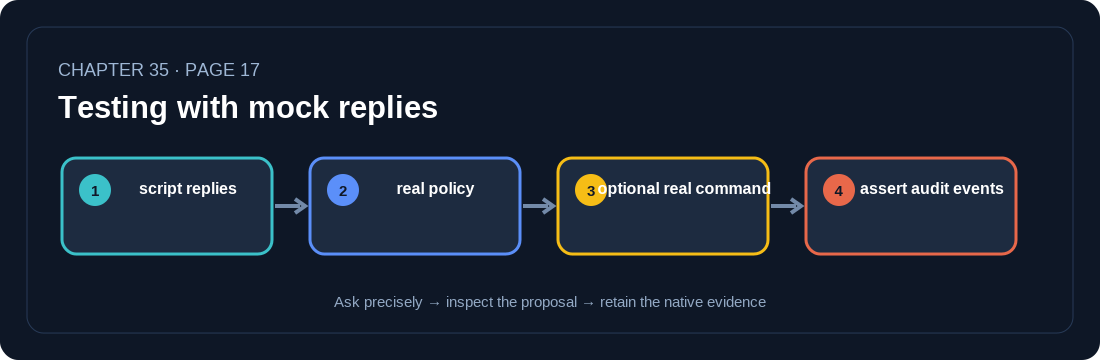
--llm-backend mock --llm-script replies.json replays a JSON list. The language turn is scripted, but help/manual/read/save, policy, confirmation, child execution, settings, result handling and audit are real. This supports deterministic demonstrations and regression tests.
How to use it
Build scripts for success, refusal, question, malformed/unknown option, bad template key, correction, repeated failure, max-steps, confirmation and guide behavior. Assert exit code plus audit events, executed command count, refusal reason, settings content, output confinement and checksums.
Practical interpretation
Chapter 35 preserves six mock sessions: help/docs/read, guide, save-and-run ER, bad key, failed-path correction, and unanswered question. Chapter 34 adds approved, plan-only and self-call refusal evidence.
Executed/reference evidence: Bad-key transcript.
Building a useful mock suite
A mock script is an ordered list of model replies, so write it to exercise the state transition you care about. A simple run script proposes one valid command. A correction script proposes a known failure and then a materially changed command. A refusal script proposes a forbidden action. A question script returns a question. A save script requests a template, saves valid settings, and proposes the corresponding child command.
Assertions should inspect more than console text: normalized action, refusal category, confirmation behavior, number/order of commands, child exit codes, settings snapshots, output paths, request end reason, and checksum verification. Use temporary or chapter-owned output directories so tests are isolated. Because the mock backend bypasses actual language generation, it is ideal for testing deterministic orchestration after a code change. It cannot establish whether a real model will choose the intended action, summarize faithfully, or remain stable under paraphrase.
A safe novice workflow
- Start with the narrowest backend, policy, files and command set that can answer the request.
- Name exact inputs and decisions; use guide or plan-only before granting execution.
- Inspect the normalized command and complete settings file, not only Maxson’s explanation.
- Read request end state, native command result, warnings, outputs and checksums.
- Preserve the session and record the qualified person’s interpretation and disposition.
Review and pitfalls
A passing mock suite does not qualify real-model wording. Pair it with fixed real-model requests under plan-only/guide first, then narrowly permitted runs. Never use a random-weight test GGUF as an assistant.
- A session exit code of zero does not prove that every proposal ran or succeeded.
- Model fluency, structured JSON, and policy approval do not establish scientific validity.
- Settings and commands are reproducibility inputs; they still require versioned software and frozen data.
What to retain
Retain .ask, backend/model identity, system prompt, request, raw/normalized replies, transcript, JSONL events, settings versions, commands, child logs/outputs, checksums, exceptions, and reviewer conclusions.
Navigation
See the previous page, next page, and complete ask command and settings index.