20.9 Dosing, infusion, repeated dose, and steady state
Supported dosing includes bolus, positive RATE infusion, modeled RATE −1/−2 through Rn/Dn, bioavailability Fn, lag ALAGn, explicit or ADDL/II repeated dosing, SS=1/2 including steady-state infusions, and EVID 3/4 resets. Any route mix can occur within a subject when CMT routes it.
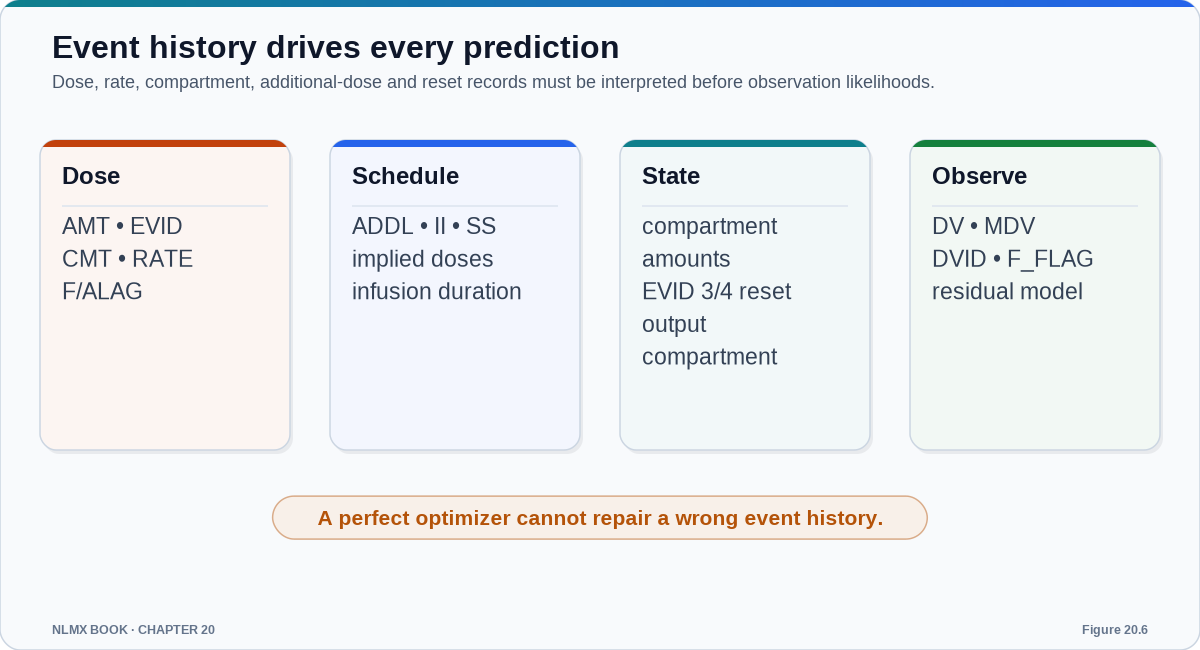
Implied ADDL doses occur even without physical rows and must affect state at later observations. Infusion stop times are events. Same-time dose/observation ordering must match NONMEM semantics. Reset events can clear compartments before dose/observation.
Validate one subject by expanding all implied events and independently simulating amounts. Include boundary cases: observation at implied-dose time, overlapping infusions, lag crossing an observation, and steady-state initialization.
Qualify each event pattern separately
Create minimal event tests before combining regimens. For a bolus, verify the instantaneous amount change and destination compartment. For an infusion, verify rate or duration interpretation, start and stop timing, and observations exactly at boundaries. For ADDL/II, expand the implied doses conceptually and confirm that observation ordering is consistent. For steady state, verify whether the dose itself is included and how pre-existing amounts are initialized.
Check dose units against model state units and bioavailability. An AMT in milligrams entering a concentration state without an appropriate volume conversion can yield plausible-looking but dimensionally incorrect predictions. RATE conventions can also differ across systems, so reproduce a reference trajectory rather than relying on terminology.
Event ordering at identical times is critical. Assign and verify a stable ordering for reset, dose and observation records. Include tests for multiple doses at the same time, zero-duration or invalid infusions, missing compartments and interoccasion resets. Reject impossible combinations clearly instead of allowing optimization to compensate.
Common mistakes
Do not treat RATE as duration, ignore negative modeled-rate conventions, expand ADDL twice, or sort same-time rows arbitrarily. SS records are not equivalent to many explicit doses unless initialization semantics match.
Checklist
- Enumerate all explicit/implied events.
- Verify CMT, RATE, II, ADDL, SS.
- Test same-time ordering and resets.
- Confirm bioavailability/lag.
- Compare with reference simulator.
Further reading
Continue to compartments and Chapter 12 dosing QC.