22.5 Statistical evidence and clinical relevance
Statistical evidence asks whether the data distinguish an effect from the null under a specified model and procedure. Clinical relevance asks whether plausible values of that effect materially change exposure, response, safety, efficacy, or dosing. They are related but not equivalent.
A precisely estimated 5% clearance difference can be statistically compelling in a large dataset yet clinically negligible. A 40% difference in a rare subgroup can be clinically important but imprecise. Selection thresholds should not replace effect-size interpretation.
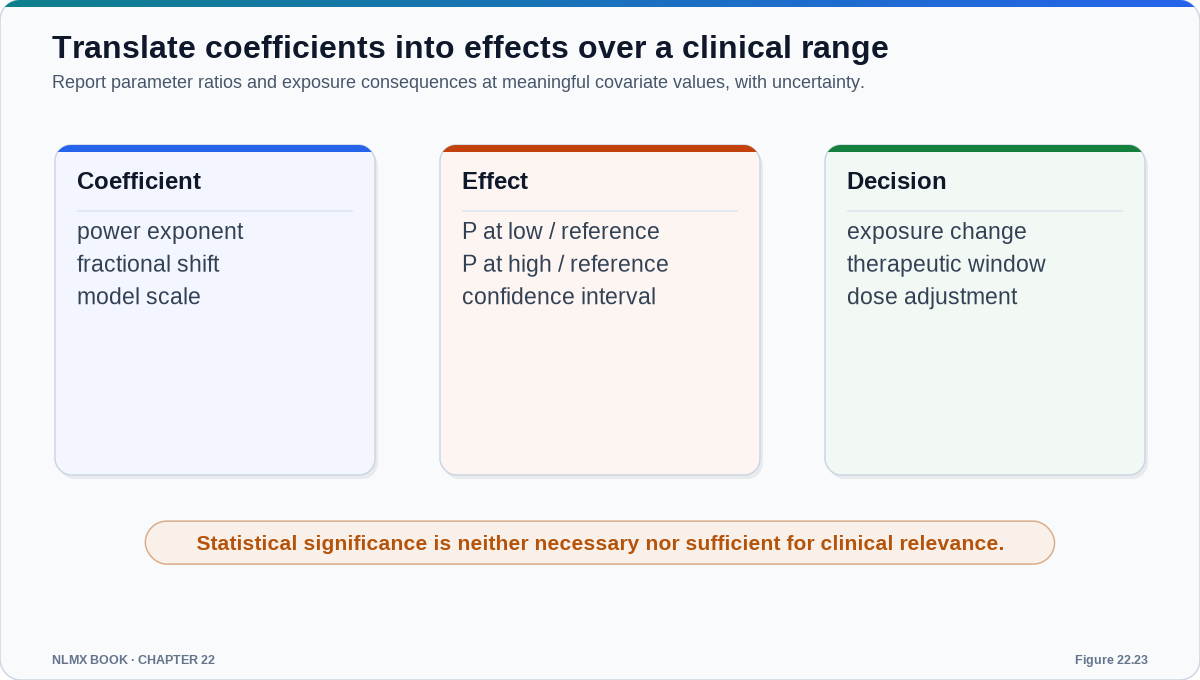
Prespecify clinical contrasts: 5th versus reference versus 95th percentile WT, renal categories, formulation, genotype, or a dosing threshold. Calculate parameter ratios with confidence intervals, then propagate them to relevant exposure metrics or simulated outcomes. Compare with therapeutic window, variability, and feasible dose strengths.
Selection introduces bias: retained coefficients tend to be exaggerated, and rejected coefficients are not necessarily zero. The joint final refit reduces some mismatch between one-step screening and the final model but does not remove post-selection uncertainty. Stability, bootstrap, external evidence, and sensitivity are important.
When an effect is mechanistically required—such as established allometric size scaling—it may be always included rather than subjected to significance selection. Report the rationale and distinguish fixed scientific structure from data-driven selection.
Common mistakes
- Equating a small p-value with dose-adjustment need.
- Declaring no effect because a threshold was missed.
- Reporting coefficients without clinically meaningful contrasts.
- Ignoring selection bias in retained estimates.
- Testing established structural relationships only for convenience.
Checklist
- Define clinical contrasts and decision thresholds.
- Report effect size and uncertainty, not p-value alone.
- Propagate effects to exposure or response.
- Distinguish mandatory science from selected terms.
- Discuss selection bias and external evidence.
Further reading
Continue with selection bias, forest plots, and Chapter 26.