20.44 Post-retry qualification and the Chapter 20 upgrade checklist
A converged retry resolves one operational question: nlmx found a convergence path from a documented alternative start. It does not establish identifiability, reliable uncertainty, adequate residual behavior, correct event interpretation, or clinical plausibility. Apply the same qualification gates used for every final model, with additional attention to starting-value sensitivity.
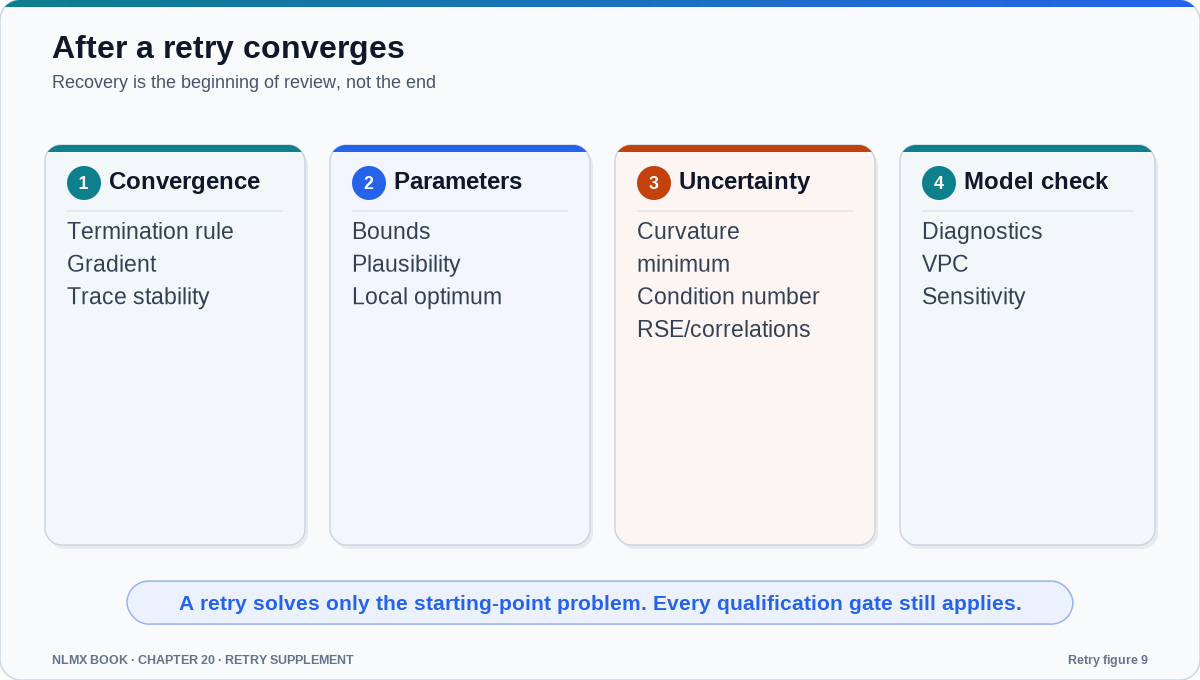
Gate 1: minimization
Verify the exact successful termination, iteration count, maximum gradient, and objective trace. Compare all converged attempts. Materially different estimates or OFVs suggest multiple basins or weak identification. Re-run promising starts deliberately if needed; do not let “first convergence wins” become “first convergence is scientifically best.”
Gate 2: parameters and boundaries
Review every estimate, unit, transformation, bound, variance, and correlation. nlmx marks estimates near THETA bounds, collapsed OMEGA/SIGMA variances, and correlations near ±1. A retry can move away from a poor start yet converge on a boundary because the model or data provide insufficient information.
Gate 3: covariance and curvature
Current nlmx rejects uncertainty when the checked R or S curvature has a non-positive diagonal, material negative scaled eigenvalue, or rank deficiency. Read the curvature block in fit_summary.json, the correlation-matrix condition number, the condition number excluding boundary parameters, RSEs, and high parameter correlations. A completed covariance step does not repair nonconvergence; a converged minimization with failed covariance is not adequate for ordinary Wald inference.
Gate 4: individual and predictive diagnostics
Review EBE behavior, shrinkage, correlated ETAs, residual plots, individual profiles, stratified GOF, and VPC. Ensure excluded predose records, carried columns, filters, and transformations match the intended analysis population. Chapter 21 covers these diagnostics; Chapter 27 will add VPC workflows.
Upgrade checklist for older Chapter 20 workflows
- Replace the earlier 4.7.0 scope statement with nlmx 4.14.3.
- Add
--retry Nto the complete command index, with its 0–10 range and default 0. - State that retry 1 uses autoinit when supported and otherwise a disclosed random fallback.
- State that retries 2–N use deterministic ±15% perturbations governed by
--seed. - Archive
retries.csv, every starting control, and every attempt used in decisions. - Distinguish process success from
converged=true. - Use the winning retry directory for covariate, forest, simulation, and VPC work.
- Capture effective estimation settings with
--print-optionsandfit_command.txt. - Apply current curvature, boundary, correlation, and condition-number review.
- Preserve source inputs and never overwrite the original attempt during promotion.
Common mistakes
- Stopping review at the word “converged.”
- Ignoring a failed covariance step or near-boundary component.
- Reporting only the winning retry and hiding initialization sensitivity.
- Promoting the parent output rather than the winning retry folder.
Final reporting language
Report the retry limit, seed, number of attempts actually made, start-generation method, winning attempt, convergence rule, OFV, gradient, covariance status, boundary warnings, and whether alternative converged solutions were found. Clearly separate numerical recovery from model qualification.
Further reading
Return to the complete fit index, diagnostic decision framework, and NONMEM reproduction workflow.