19.17 Stationarity test
Every 25 burn-in iterations after the first 100, nlmx examines a recent window \(w=\min(\max(k/3,50),200)\). Each estimated transformed parameter and SAEM trace objective is divided into ten batch means to reduce autocorrelation. A regression slope gets a t statistic with eight degrees of freedom.
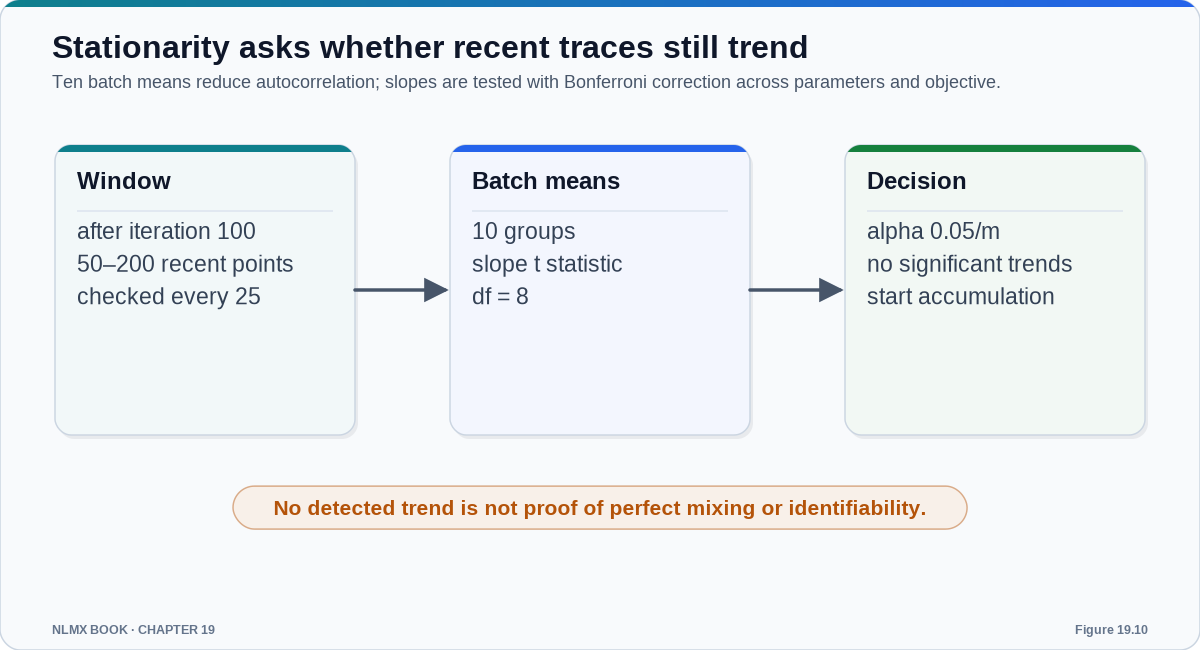
The threshold uses level (0.05/m), Bonferroni-corrected over all tested series. Burn-in ends when none shows a significant trend. This is a conservative trend screen, not proof of mixing, unimodality or convergence to global maximum.
Autocorrelation beyond batch absorption, oscillation without linear trend, or mode trapping can pass. Therefore combine the test with traces, acceptance, seed sensitivity and final diagnostics.
Practical interpretation
Reproduce one stationarity decision from stored traces: select the documented window, form ten equal batch means, regress them on batch index, calculate the slope t statistic, and compare with the Bonferroni-adjusted \(t_8\) threshold. This confirms indexing and multiplicity. Then inspect the raw trace to see behavior the slope test misses.
A run reaching NBURN without passing should be labeled nonstationary even if final estimates appear plausible. Any continuation belongs to a documented new run with a longer budget or model correction.
Test the procedure on simulated stationary autocorrelated noise and on known trends. A good implementation should avoid excessive false trend detection while reliably rejecting sustained drift under the documented multiplicity correction.
Retain batch means and individual test statistics in validation artifacts when diagnosing unexpected phase transitions.
Common mistakes
Do not call “no detected trend” full convergence, ignore multiple-testing correction, or apply ordinary pointwise regression to autocorrelated iterations.
Checklist
- Confirm window and ten batches.
- Test transformed parameters plus objective.
- Apply Bonferroni threshold.
- Record iteration of stationarity.
- Supplement with mixing diagnostics.
Further reading
Proceed to accumulation and diagnostics/settings.