17.12 Autoinit starts and parameter mapping
The first candidate needs starting values for fixed effects, random-effect variances and residual error. With automatic initialization, screen invokes the route- and design-aware machinery documented in Chapter 16. It combines supported NCA, individual nonlinear fits and simulation-neighbour evidence, then maps recommendations into the parameter names of the candidate.
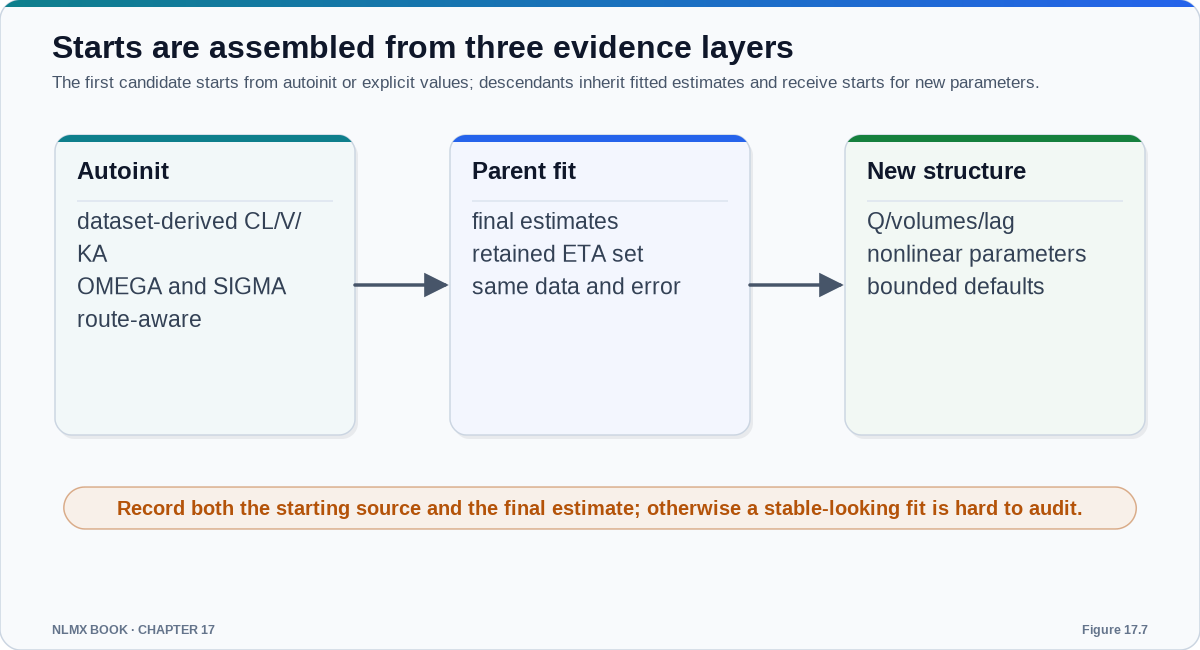
Mapping is structural. A generic volume estimate may initialize V in one compartment or central V2 in a larger model. Oral data produce apparent CL/F and V/F unless absolute bioavailability is estimable. KA, lag, peripheral volumes and intercompartmental clearances are included only where the family requires them. Scaling and units must agree with the generated control stream.
The settings file can control autoinit method, Monte Carlo samples, neighbours, iterations, seed, threads and scale. More samples may stabilize simulation-based starts but do not create information. An explicit initial-value section can replace or supplement automatic proposals when prior fits or justified literature values exist.
Read “Initial values used” in screen_summary.txt. It identifies autoinit for roots and parent-final estimates for descendants. Compare those values with final estimates. Very large movements, boundary estimates or inconsistent units can reveal a poor basin even when the optimizer reports convergence.
Common mistakes
Do not regard an autoinit recommendation as a population estimate, paste apparent oral clearance into an IV parameterization, or alter starts until a preferred candidate wins. A fixed random-effect floor may be a numerical convenience rather than evidence of true variability.
Checklist
- Confirm units, scale and apparent-versus-absolute meaning.
- Inspect method evidence and notes from autoinit.
- Verify name mapping for every candidate family.
- Compare start and final values for large shifts.
- Run alternative justified starts for fragile results.
Further reading
Read Chapter 16 in full, then parent warm starts and estimation numerics.