23.30 Base-parameter uncertainty from the covariance matrix
When a usable .cov is available, frozen-parameter uncertainty is enabled by default. nlmx draws nuisance parameters from N(ψ̂, Cov) and evaluates how candidate evidence changes. It reports pass probability at the forward alpha, sign stability of the one-step coefficient, median score statistic, 5th/95th percentiles, invalid draws, and draw count.
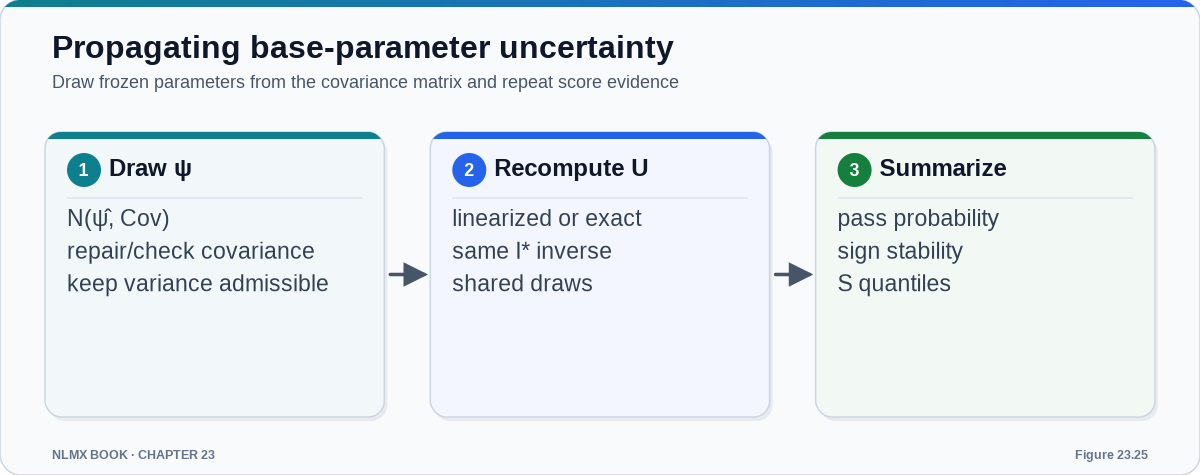
This analysis asks whether the screening conclusion is sensitive to uncertainty in the base estimate. It is not a posterior probability that the relationship is true. The covariance matrix must match parameter labels and scale and be factorable. nlmx may project a nearly PSD covariance matrix and reports the relative repair; inadmissible variance draws are kept positive by a guardrail. Large repairs or many invalid draws weaken interpretation.
--draws controls Monte Carlo resolution and --seed controls reproducibility. --no-uncertainty can be appropriate for a speed sensitivity or when no qualified covariance exists, but disabling uncertainty must not be used merely to remove an uncertain label. Candidate-only information may lack the cross-information required for linearized propagation.
Interpreting pass probability and sign stability together
A high pass probability with high sign stability describes a candidate whose local evidence remains strong and directional across base-parameter draws. Low pass probability with unstable sign supports rejection or further scrutiny. High sign stability but intermediate pass probability can mean a consistent direction with uncertain strength, while high pass probability and low sign stability can occur in multi-column or poorly coded cases and requires inspection. Always read score quantiles and invalid-draw counts alongside the two probabilities. A retained label can still have wide effect uncertainty after joint refitting because this exercise concerns screening evidence, not the final coefficient distribution.
Common mistakes
- Calling pass probability a Bayesian posterior inclusion probability.
- Using
.covfrom another fit or parameter transform. - Ignoring covariance repairs and invalid draws.
- Comparing probabilities from different alphas or draw counts.
- Disabling uncertainty after seeing an inconvenient classification.
Checklist
- Verify covariance identity, labels, conditioning, and repair.
- Record draw count, seed, alpha, and mode.
- Review pass probability, sign stability, and statistic quantiles.
- Repeat borderline probabilities with more draws.
- Keep uncertainty evidence separate from final effect CI.
Further reading
Continue to linearized versus exact propagation and Chapter 20's covariance-output documentation.