19.20 Importance-sampling objective
After SAEM, nlmx estimates each subject’s marginal ETA integral with importance sampling. It draws from a tractable proposal \(q_i\) near the conditional posterior and corrects each draw with target/proposal weight.
For \(M\) draws,
OFV_i = log|OMEGA| + p log(2π)
        − 2 log mean_m { exp[−J_i(eta_m)/2] / q_i(eta_m) }.
The total reportable OFV sums subjects. This corresponds to NONMEM METHOD=IMP EONLY=1. With --approximation saem --max-iterations 0, nlmx can evaluate this objective without new SAEM estimation at supplied parameters.
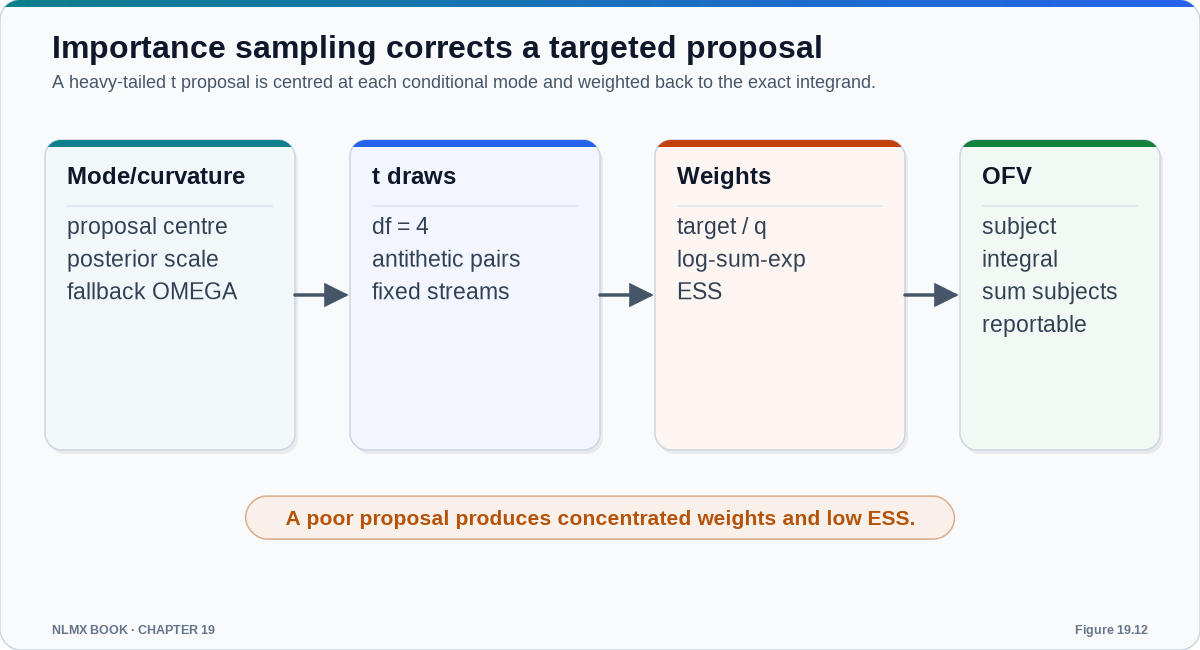
Finite M creates Monte Carlo error. Compare models only with the same method and adequate draws/ESS. Common random numbers make perturbation-based covariance smoother.
Practical interpretation
For one subject, calculate log target and log proposal for each draw, subtract to obtain log weights, and compare log-mean-exp with a brute-force integral in one ETA dimension. Increase draws in a nested sequence so estimates show convergence without changing earlier samples. Repeat seeds to estimate Monte Carlo variability.
When candidate OFV differences are similar to that variability, do not declare a winner. Increase draws or report uncertainty. Information criteria inherit the same Monte Carlo error because their penalty is deterministic but OFV is estimated.
Use the same proposal-construction rules and adequate draw policy across candidates. Candidate-specific ESS may require raising M globally or documenting adaptive draw increases without biasing selection.
Archive per-subject contributions so an OFV discrepancy can be localized rather than treated only as a population total.
Common mistakes
Do not call finite-sample IMP exact, mix it with SAEM trace objective, or compare with FOCE-I OFV as though they estimate the identical approximation.
Checklist
- Confirm proposal and weight formula.
- Use log-sum-exp.
- Report draws and ESS.
- Repeat/extend for Monte Carlo stability.
- Compare models within the same objective method.
Further reading
Next: proposal design and weights/ESS.