24.19 Subsampling, bootstrap, and repeated k-fold
subsample draws a configured fraction without replacement. Smaller fractions perturb the sample more strongly and usually reduce selection probabilities. bootstrap samples subjects with replacement; duplicates alter weights and expose sampling variability. repeated-kfold cycles through repeated partitions and is useful when prediction-oriented tuning or balanced coverage is desired.
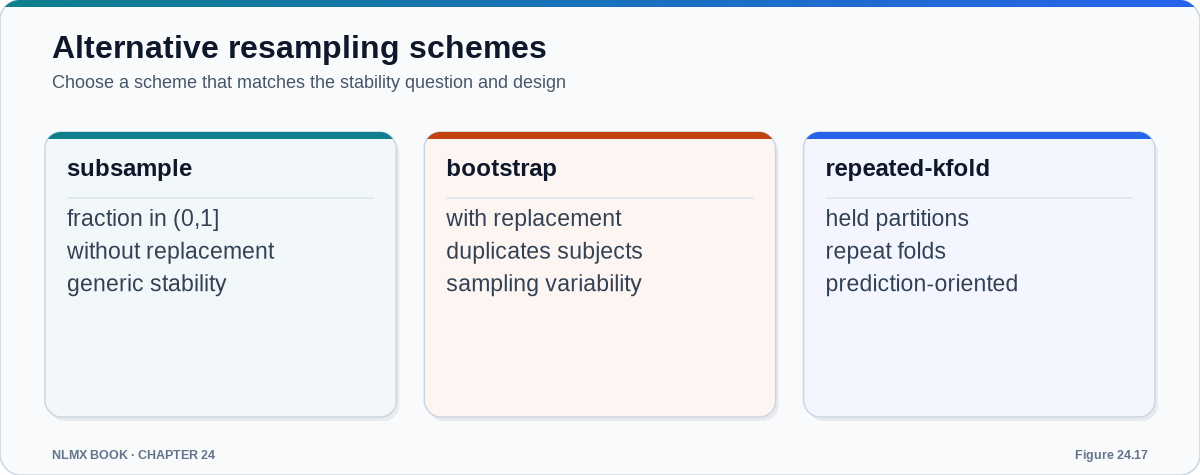
The scheme changes the stability estimand. The teaching bootstrap variant retained all three true continuous effects, whereas the primary complementary-pair run placed CL–EGFR at 0.717 and uncertain. This does not prove bootstrap is superior: its larger effective sample and duplicate weighting produce a different perturbation.
Choose before analysis and validate operating characteristics under realistic designs.
Common mistakes
- Comparing probabilities across schemes without context.
- Calling bootstrap subjects independent duplicates.
- Using fraction 1.0 subsampling and expecting strong perturbation.
- Ignoring fold/stratum balance.
- Selecting a scheme because it retains a preferred effect.
Checklist
- Match scheme to the stability question.
- Record fraction/folds and replacement behavior.
- Review effective sample and category support.
- Label cross-scheme sensitivity clearly.
- Simulate type-I error and power for the primary scheme.
Further reading
See subject resampling, stratification, and worked variants.