Worked interruption, resume, and protective refusal
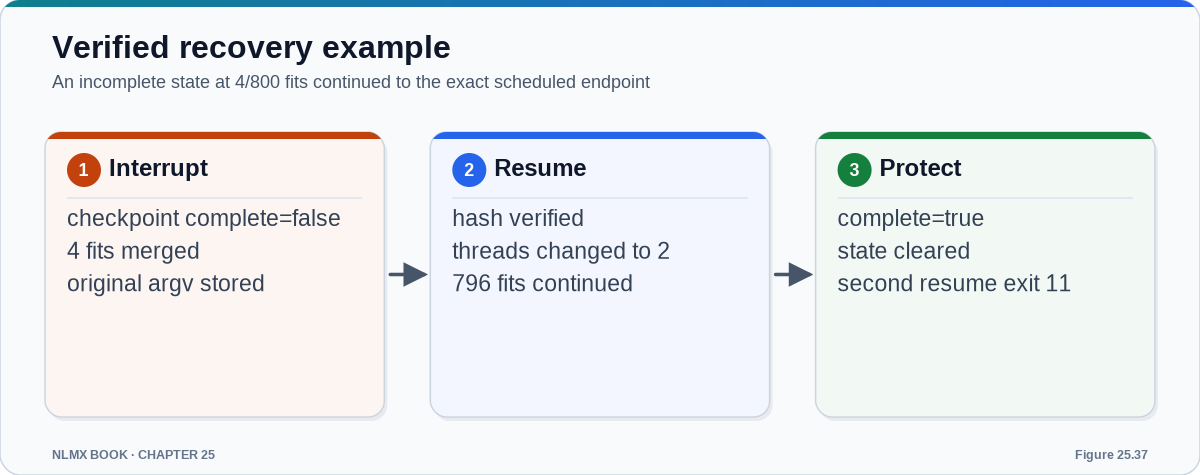
A real posterior run scheduled 800 learner fits (400 complementary-pair resamples × one draw × one learner × two ETAs) with checkpoint interval one. The process was terminated after an atomic incomplete checkpoint recorded four completed fits. The checkpoint preserved original argv, analysis hash, versions, and aggregate state.
nlmx resume --run-dir ... --threads 2 reparsed the original command, verified the analysis hash, accepted the changed worker count, and continued the remaining schedule to 800 completed fits. The final checkpoint is complete=true with cleared state. Results retained CL–WT and V–WT, marked CL–EGFR uncertain, and rejected both SEX effects.
A second resume attempt was refused with exit code 11 and “already completed.” This proves all three behaviors in the same artifact set: partial work is reusable, operational parallelism may change, and a closed run cannot be reopened as though it were interrupted.
An uninterrupted control run used the identical numerical configuration. Ten key endpoint artifacts—including analysis_results.json, selection probabilities, coefficient/form/learner summaries, variance consistency, retained relationships, equations, and both draft-model files—were byte-for-byte identical to the recovered run. Logs and checkpoints appropriately differ because they describe different operational histories.
Common mistakes
- Changing the scientific question after seeing the result while presenting it as the original run.
- Reading one engine's summary without checking its prerequisites, failures, normalized settings, and fitted endpoint.
- Treating a generated draft, comparison label, or completed checkpoint as a substitute for model diagnostics and reference-software confirmation.
Page checklist
- The exact command, version, inputs, resolved settings, and output directory are identifiable.
- Engine-specific evidence is interpreted on its own scale before cross-method comparison.
- Recovery state, final refit, diagnostics, and remaining confirmation work are explicit.